By Timothy Doyle (Deadspin, 11/11/2012)
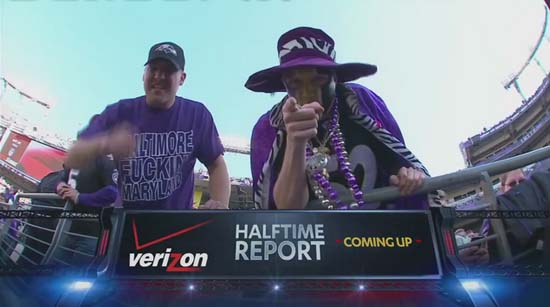
It’s America’s most-watched network for a reason. Coming up at the half, it’s Shannon, Boomer, and the others with the fuckin’ Verizon halftime report.
Click to watch video clip on Deadspin.
By Timothy Doyle (Deadspin, 11/11/2012)
It’s America’s most-watched network for a reason. Coming up at the half, it’s Shannon, Boomer, and the others with the fuckin’ Verizon halftime report.
Click to watch video clip on Deadspin.
Columnist Mike Moran wishes a group some have called racist would find a new name.
By Mike Moran (North Baltimore Patch, 11/8/2012)
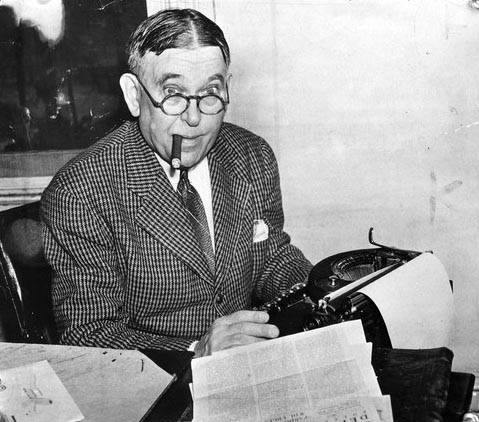
On Nov. 9 of this year, the fifth annual conference of the H.L. Mencken Club will be kicking off, just outside of Baltimore in BWI’s hotel district. How honored we Baltimoreans must be for this elite society to have christened itself with the name of one of our most beloved citizens, the great early 20th century writer, skeptic, and old-timey smart-ass, H.L. Mencken. With this year’s topic of “Challenging the Historical Consensus,” the H.L. Mencken Club will, no doubt, celebrate its namesake’s legacy of skepticism, witty intellect and of course white supremacy…
…wait, what?
Well, here’s the thing, the group known as The H.L. Mencken Club is part of the “paleoconservative” movement, a political ideology that stresses the strict preservation of Western culture to such a degree that they’ve been referred to by some as “suit and tie Nazis” and “uptown Klan.”
The small but growing society, keeps distant from the usual “white power” suspects as these fellows (and there aren’t many women) are armed with masters degrees, articulation, and enough sense to keep things low-key. There won’t be any cross burnings, sieg-heilings, or adorably groomed Hitler-staches here.
It’s difficult to nail down the exact views of the HL Mencken club members. A casual foray into theirwebsite, podcasts and the various writings of the club’s all-star players, presents a bizarre mixed bag of political philosophies. Antipathy toward the immigration of non-whites to the U.S. seems to be the one thing the group agrees on. The rest is a strange blend of relatively innocent ideas akin to “small r” republicanism and isolationism, mixed with disturbingly academic versions of social Darwinism,racial eugenics, and the preservation of white-Christian heritage.
Continue reading “H.L. Mencken Club vs. H.L. Mencken” at North Baltimore Patch.
By Keith Eggener (Places, 10/22/2012)
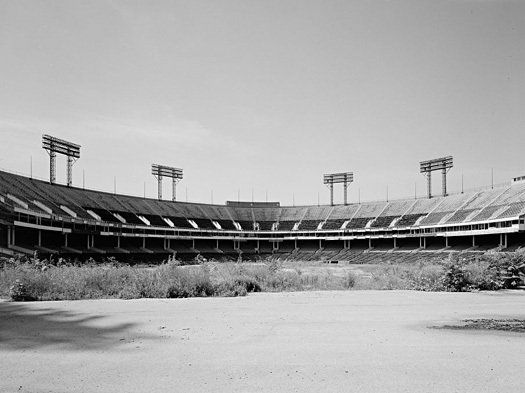
Baltimore Memorial Stadium, 1949, photographed in 2000. [Photo by the Historic American Buildings Survey]
“…Fan reaction to the threat of loss was intense and highly personal. Humanized in life, “the old gray lady” was likewise mourned in death, like a friend or family member finally laid out in the parlor where she’d long sat fading. People emphasized their connection to the place, the effect of its decay and possible destruction upon themselves, the ache they felt in watching these things occur. “You never thought you could get so attached to a building,” said one person interviewed for the documentary The Last Season, “but it’s going to be hard seeing this thing going down. … it’s like losing a friend.” “Memorial Stadium is just like a family member,” said another, “and watching it be demolished is like watching a close family member going through a long and painful death.” For still another fan the loss was like a quicker kind of death, one no less brutal or difficult to witness. “I don’t think it could be any sadder to watch someone executed. To have so many memories erased in seconds.” Memory and its erasure were often noted, and losing BMS was said by many to be like losing a part of one’s self. “It’s not just a building they’re tearing down,” one man said, “it’s memories, it’s my childhood.” [23]
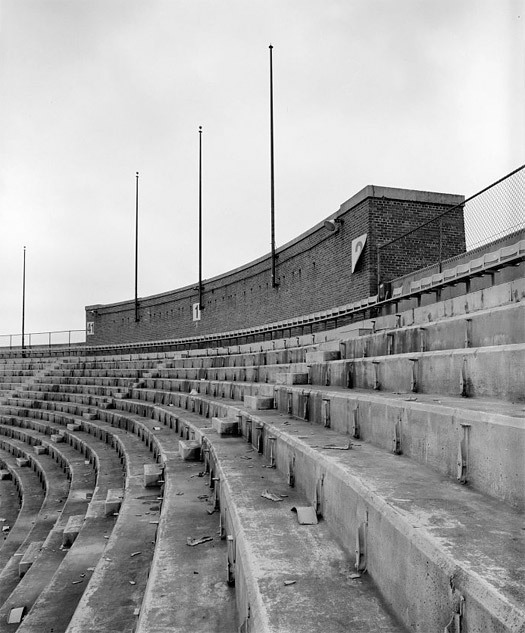
In March 2001, 52 years after construction there began, Baltimore Memorial Stadium was demolished. As part of a compromise brokered by Mayor Martin O’Malley between those wanting to clear and redevelop the site and those wanting to preserve it, the memorial wall was left standing. The state of Maryland spent $750,000 to reinforce it. [24] The compromise was not a popular one.
For five months the reinforced memorial wall stood on its own, tall as a ten-story building, surrounded by roads and empty lots, disconnected from everything around it, like a defunct drive-in movie screen rising from a field of weeds and trash. Said former Baltimore Mayor and Maryland Governor William Donald Schaefer, in an opinion published in The Baltimore Sun on November 11, 2001, two months after the attacks of 9/11: “We should all be ashamed for the travesty that has been created out of the opportunity to redevelop Memorial Stadium, a monument to those who served our country in a time not unlike that which we face today…. [the wall is] a forlorn vestige of the proud landmark.” [25] Neighborhood activists saw the freestanding wall as “an incongruous eyesore without the rest of the stadium.” Veterans’ groups and the Baltimore City Council agreed and, opposition from local preservationists notwithstanding, the wall’s destruction was approved. [26] It came down just after Christmas in 2001.”
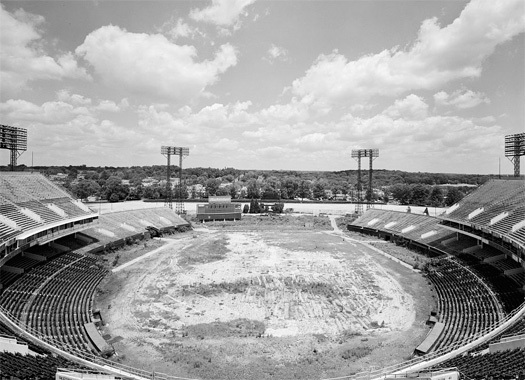
Baltimore Memorial Stadium. [Photos by the Historic American Buildings Survey]
By Tom Warner (Accelerated Decrepitude, 10/15/2012)
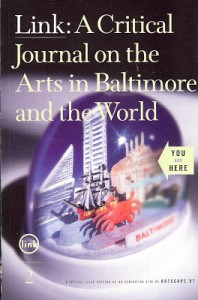
You Are Here: Link No. 2 (1997)
The Baltimore-based arts magazine Link published 10 book-length journals to great critical acclaim between 1996 and 2006. I was never fully aware of Baltimore’s arts scene in my formative years of the late ’70s through the early ’90s – when, apparently, a lot of exciting things were happening here – but, in the course of rummaging through my warehouse-sized archive of accumulated books and magazines this weekend, I had an epiphany when I came across Link No. 2,” a special issue serving as an exhibition site of Artscape ’97.”
I confess, I had never read this issue in detail, but thumbing through its pages now, I noticed a lot of familiar (and respected) names from Baltimore’s arts and music scenes past: Kirby Malone, D.S. Bakker, Susan Lowe, Peter Walsh, David Beaudouin, Sandie Castle, David Franks, tENTATIVELY a cONVENIENCE, Tom DiVenti, Steve Estes, John and Richard Ellsberry…and (drum roll, please) Link co-founder and Creative Alliance co-founder/program manager Megan Hamilton.
Megan’s opening article “Stenciled on Marble Steps, Woven into Rows: Assembling a Baltimore Historian” spoke to me immediately, for it brought home recovered memories of scenes, places, people, and events of which I had only a hazy recollection. As she wrote in her opening paragraph:
“I write a history titles The Era of Spectacle and The Banquet Years: Baltimore Performance Art 1968-1985. I interview artists, on tape, about events that are often ten, sometines going on twenty years old. Occasionally trying to remember a long-ago, now fuzzy detail, they will turn to me and ask, “Don’t you remember? You were there, weren’t you?” I don’t know how to answer. What I really feel like saying – but only occasionally have the guts to – is: “Yeah, I was there, but I didn’t get it.” Even more strangely: “But I think that, even though I didn’t get it, it got me – somehow snuck into my marrow so that now I try to write a history of the stuff I didn’t get in the first place.”
Yes!!! This is exactly how I feel when I try to explain to people my piecemeal recollections of moments and experiences I lived through, like the Ad-Hoc Fiascos in Wyman Park (1983), the old Second Story Books and Empire Salon on Charles Street in Mt. Vernon (1981-1982), the Crater Baltimore Alliance project, the Cultural Cryptananalysts Collective‘s stencil art project, the Museum of the Future, the TESTES-3 interactive phone line-answering machine (new technology in 1980!)-radio station project (produced by Richard Ellsberry, Doug Retzler and tENTATIVELY a cCONVENIENCE), the video wizardry of Ed “Lizard” Rosen, and the various audiovisual projects of John and Richard Ellsberry. And now, thanks to Megan, at least some of these happenings have been documented so that future generations (not to mention those time-traveling Krononauts from the future who visited Charm City in the near-past) can “get it” as well.
Continue reading “Link: A Remembrance of Local Arts Scenes Past” at Tom Warner’s Accelerated Decrepitude.
