How Maryland Got Its Names

By Shirley Grace (Maryland Life Magazine, 4/25/2012)
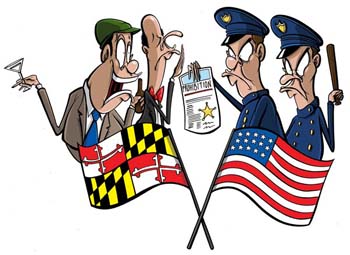
Illustration by Matt Mignanelli

“According to what I found in the glorious Maryland Room of the Enoch Pratt Free Library, George Washington gets the credit for Maryland being known as the Old Line State. But did you think, as I did, that it had something to do with the Mason-Dixon Line?

Wrong. Completely unrelated.

Rather, it’s directly linked to Maryland’s contribution to the Revolutionary War. General Washington appealed to the states at that time to send men to help the Continental Army fight off the British. These groups of men were called a “line”—thus, the Maryland Line…”

– – –

“Maryland’s other popular nickname, the Free State, is steeped in Prohibition. The Maryland government at that time refused to pass a law explicitly outlawing alcohol. This cheesed off Georgia Congressman William D. Upshaw, who made a long speech in 1923, accusing Maryland of being reprobate for not supporting going dry…”

– – –

“Anyway, those two nicknames are the biggies, but there are others, such as the Cockade State…”

Continue reading “How Maryland Got Its Names” at Maryland Life Magazine.
Posted in Decades, Roadside Attractions | Leave a comment

PETA’s Vegan Bikini Girl on Baltimore’s Fire Trucks?

By Rachel Monroe (Baltimore Fishbowl, 4/24/2012)


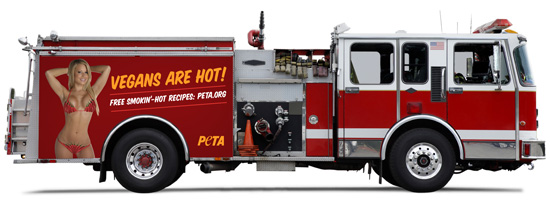
Vegans are hot! Click for hi-res PDF.

Animal-rights group PETA doesn’t shy from controversy — in fact, quite the opposite. So I suppose it’s no surprise that when Baltimore City Councilmember William “Pete” Welch floated the idea of including ads on city fire trucks as a way to raise funds for trucks that would otherwise have to disband, PETA saw it as an opportunity. While the Baltimore Brew imagined what our city would look like with a Food4Less or Big Boyz Bail Bonds fire truck, PETA’s proposed ad continues the organization’s long history of using hot women to promote animal activism.

Continue reading “PETA’s Vegan Bikini Girl on Baltimore’s Fire Trucks?” at Baltimore Fishbowl.

Posted in 2010s, Baltimorons, Pranks, Roadside Attractions | Tagged | Leave a comment

Bromo Seltzer Tower


(birdstendtofly.tumblr.com via fyeahmaryland.tumblr.com.)

Posted in 2010s, Photographs | Leave a comment

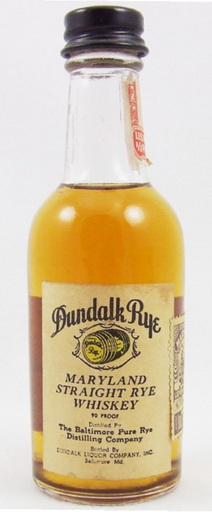
The Baltimore Pure Rye Distilling Co. — Dundalk, Maryland

(By Linda and John Lipman, American Whiskey)

IN THE 1930’s, shortly after the 18th amendment was repealed, two distilleries were built in the countryside east of Baltimore. The area is known as Dundalk. The topsy-turvy shuffling of market positions that marked the post-prohibition scramble is well illustrated by these two plants, located virtually next-door to one another.

One distillery was built on farm land just off Sollers Point Road in the 1930s. It’s hard to believe today, but the population of Dundalk at that time was less than 8,000, mostly employees of the Maryland Steel Company at nearby Sparrows Point.

The distillery was the Baltimore Pure Rye distillery, and the brick smokestack bearing its name still stands. But the distillery it stands over is known to most people as Seagram’s. Baltimore Pure Rye closed in 1957, and Seagram’s purchased it to produce Paul Jones and Four Roses. This is somewhat confusing, since Seagram’s bought these brands as part of their purchase of Frankfort Distillery in the early 1940s. Frankfort Distillery was not single plant, but a Louisville-based company owned by the Paul Jones Company, which owned a number of distilleries and brands. Among the brands was Four Roses, and among the distilleries was the other Dundalk plant, located on Willow Spring Road, around the corner from Baltimore Pure Rye. Of course, the purchase of Frankfort Distillery included that site as well, and they were already running their original Baltimore distillery, Calvert, not far away.

Continue reading “The Baltimore Pure Rye Distilling Co. — Dundalk, Maryland” at American Whiskey: Rye Distilleries of Eastern Pennsylvania & Maryland.

Posted in Booze, Dundalk | 2 Comments