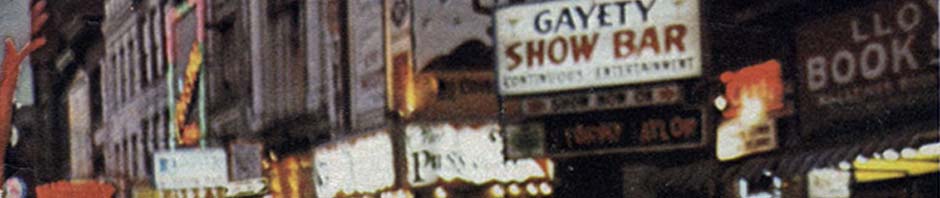
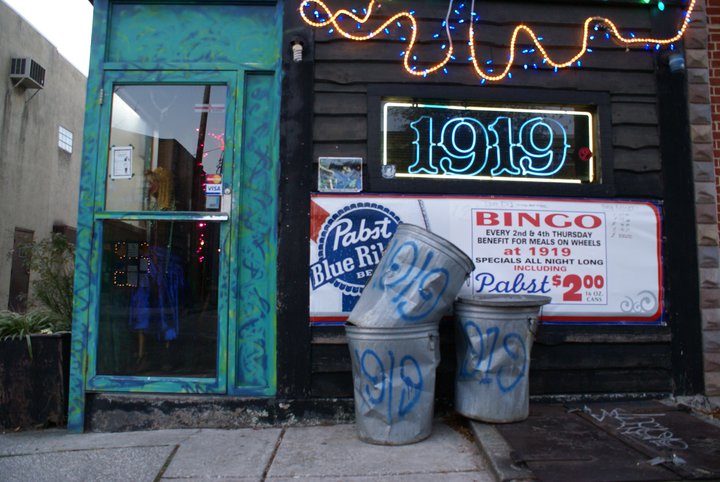
Somewhere in Fells Point, Maryland, hopefully near the 1919, Mr. Lucky performs the “Lone Ranger Theme” (Ok, the “William Tell Overture”) on his harmonica.
1919 Fleet Street. Tell them The Captain sent you.
By Michael Anft, Photos by Steven Brown (Baltimore City Paper, 2/16/1990)
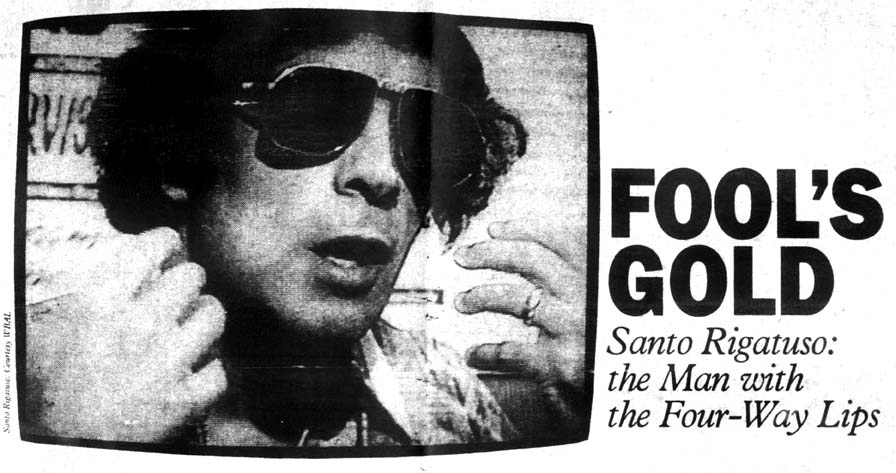
David B. Irwin had just formed his own law firm with four associates. His library wasn’t yet stocked and furniture was still being moved in when his firm’s first client, referred by another lawyer, made his way through the door. Even if Santo Victor Rigatuso hadn’t been Irwin’s first client in October 1988, Irwin says he would have no trouble remembering him. “I’ll never forget him sitting in my library,” Irwin says. “He’s an interesting-looking person. He was wearing a floppy, cowboy-type hat pulled down over curly black hair and sunglasses. He had quite a presence about him.”
Rigatuso, known to Irwin at the time as Bob Harris (the most-used of his dozen or so aliases), had reached TV viewers across the country with his Santo Gold and Forever Gold promotions, which ran on over 100 channels nationwide from 1982 to 1986. Seizing upon mail order and TV ads as a way to get rich, Rigatuso, a former barber and music shop owner, concocted schemes for selling jewelry and credit cards that netted him millions of dollars.
“He’s got more ideas and energy than anyone I’ve ever met,” says Irwin.
Besides his various retail ploys, Rigatuso (again under the name of Bob Harris) found the time to produce, write, and star in his own, self-proclaimed “vanity film,” Blood Circus, which was billed as “the atomic wrestling movie.”
Santo Rigatuso is a ninth-grade dropout who grew up in working-class Pigtown and achieved wealth in spite of social problems brought on by episodes of Tourette Syndrome, a neurological disorder characterized by nervous tics and involuntary, inappropriate utterances. Evidence offered in some of his court cases points to Rigatuso as a man who purportedly lived the American Dream, but his story isn’t exactly the stuff of a Horatio Alger novel. According to those who followed his rise and fall, Rigatuso’s business ingenuity, like much of his merchandise, was a sham.
“What you have [in Rigatuso] is a guy, who has basically changed his name and those of his companies, even though they were all doing the same thing—defrauding the public,” says Fred Addison, a postal inspector in Virginia. The aliases, Addison contends, were a way for Rigatuso “to stay one step ahead of the authorities.”
Roger Wolf, a special prosecutor for the Maryland Attorney General’s Consumer Protection Division (CPD), adds that Rigatuso had a way of fending off consumer complaints. “It was a new corporation almost every week,” he says. “As some complaint would develop against one [corporation] he would change its name and slightly change his solicitation letters.”
In 1982 Rigatuso received the first of four cease-and-desist orders from the U.S. Postal Service, which were aimed at forcing Rigatuso to abide by postal regulations. By 1984 Rigatuso had become a regular subject of consumer-beware pieces on local TV newsshows. But despite all the attention Rigatuso’s schemes grew more grandiose. “As time progressed,” says Dick Irby, former consumer reporter for WMAR-TV, “[Rigatuso] just seemed to get bolder and bolder.”
Sometime in 1972 a wooden bung was pounded home, and the last barrel of Pikesville Maryland rye whiskey was rolled into the warehouse at Majestic’s distillery in Lansdowne. And with that event, the great Maryland rye whiskey industry, which had once been a major player in the American whiskey business, came to a final close.
Well, sort of… Straight rye whiskey isn’t “done yet” until it’s aged in a new charred oak barrel for upwards of four years, so it would be the mid-to-late seventies at the earliest before it would be bottled. Some would continue to age well into the early ’80s. The company that made it didn’t close; they just stopped distilling new whiskey. Pikesville would continue to be bottled there for several years. But the whiskey would be from other distilleries. And Majestic was the last one in Maryland.
Then again, the saga of American whiskey wouldn’t be anywhere near so fascinating if the stories were short, direct, and not intertangled with one another. And Pikesville, as the last brand to proudly wear the words “Maryland Rye” on its label, is certainly not about to be an exception to that rule.
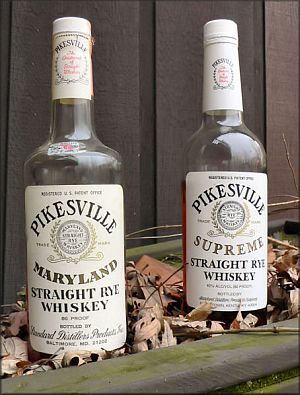
For one thing, there’s the little fact that Pikesville still exists. In fact, it may well be the most popular rye whiskey in Maryland today, easily outselling its Kentucky cousins. The complication is simply that today’s Pikesville — Pikesville Supreme Straight Rye Whiskey (as opposed to Pikesville Maryland Straight Rye Whiskey) — really is its own Kentucky cousin.
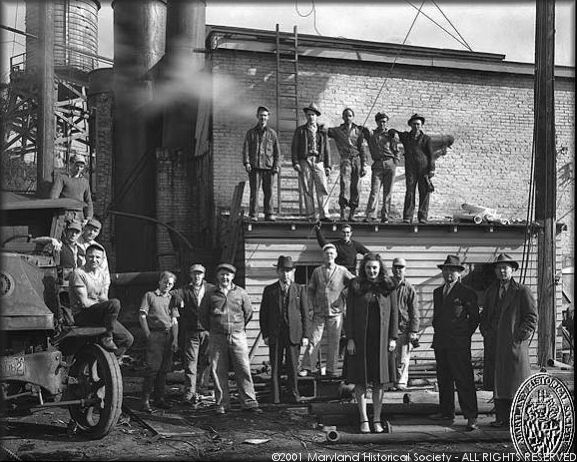
November 16, 1942 -- Monumental Distillers -- Staff and Employees
The Baltimore company that produced Pikesville when it was a Maryland rye was Standard Distillers Products, Inc., which appears to have been related to the Corporation Trust Corporation of Baltimore. Both companies shared an address at 300 East Lombard Street, and CTC were, until very recently, the owners of the Majestic Distillery where Pikesville was made and bottled for most of its post-prohibition career as a Maryland rye whiskey.
A career which met a formidable obstacle in 1972, when Majestic ceased its distilling operations, and a final blow in 1982 with the sale of the Pikesville brand to Heaven Hill of Bardstown, Kentucky. So it seems that Maryland’s most popular rye whiskey is now being made and bottled (as it has been for nearly a quarter-century now!) in Kentucky.
Continue reading “Pikesville Maryland Rye: The End of an Era” at American Whiskey.