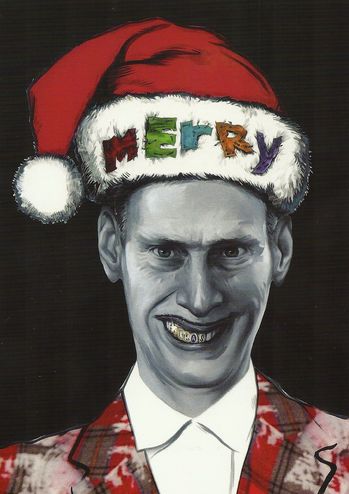
John Waters’ 2010 Christmas card, art by Richard Louderback
Roger Ebert: This is the lightly-edited full transcript for the interview I did with John Waters recently. My questions were typed, his were spoken.
Waters: There’s nothing you could ask that I would balk at. I’m pretty open.
Ebert: If I said you were not the first person I would think of for a Christmas show, would that be unfair of me?
Waters: Well, you probably thought of Johnny Mathis first. But, as I say, I am the pride of the Johnny Mathis Christmas Show and that’s why he became one of my role models and that’s why I almost stalked him and he finally agreed in a very good-natured way to take the risk to talk with me for my book and he was a great sport about it. I just went to see Johnny Mathis about two weeks ago when he was back in Baltimore, first time I’d seen him since the book, and he was so hilarious. He joked to me and said, “oh, you made me famous again.” Really made me laugh because nobody’s more famous than Johnny Mathis.
Ebert: Sometimes you yourself seem puzzled by your subjects. There is no doubt how much you admire Johnny Mathis, for example, but you have little idea what he really thinks and what his life is really like. Are you more in love with Johnny Mathis, or with the idea of Johnny Mathis?
Waters: That’s a good question. I think. I’m always in love with the idea of something more than reality because then you can’t be disappointed. When I say that I stalked Johnny Mathis, I didn’t mean it as a boyfriend; I meant it as the fan for all the wrong reasons that I hoped he would take it in the right way, and he did. But the idea of something being such a big influence on me — especially something I’m not 100% certain of why — is always the strongest attraction. I never can decide if it’s torture to be Johnny Mathis, or great freedom. And everything in my book is about people surviving and leading a more extreme life than I have. In Johnny Mathis’ case, surviving instant success from the day you started, is really, really hard to do. But people don’t realize that.
Ebert: You are the only exploitation filmmaker I can think of who seems to approach the genre from the outside. The people you most admire seem to lack your gift for introspection.
Waters: Well, the problem is, I made exploitation films for art theaters. To my great shame, they never would have worked at the Loop Theatre, my favorite ever exploitation theatre that in Chicago, that played “Vixen” 24 hours a day at some point. Because those audiences did not want irony. I felt that real exploitation audiences went for “Beyond the Valley of the Dolls,” which I still think would make a great Broadway musical. We’ve talked about that before. But my films never worked in real exploitation theaters because they were ironic and when people went to see real exploitation movies, they didn’t do it thinking they so bad they were good. They thought they really were sexy; they thought they really were scary. And I was making fun of the genre even though I loved the genre. I looked up at the genre and I asked my audience to make fun of that genre with me.
Ebert: I remember your great presentation at Telluride about William Castle and his genre. Was that the first of your lecture subjects, or do you have a repertoire?
Waters: Oh, God, I’ve been doing my spoken act and my vaudeville act, as I call it, since the ’60’s when I used to tour colleges. Today I have “This Filthy World,” of which I have a gay version, I have an art version, I have a convention version, I have a Baltimore version and I have a foreign version. And then I have a completely different show, “The John Waters Christmas,” which is what I’m coming to Chicago for, that is constantly updated and changed but I’ve been doing that for about 8 years. So I have many different vaudeville acts but they can easily be adapted. But the Christmas one is separate.
Ebert: You’re fascinated with the bizarre. Do you think that might have been hard-wired from childhood?
Waters: Well, I always from the very beginning realized I was not interested in what the other kids were. It didn’t bother me, really, and my parents were supportive even though they were frightened. I was born six weeks too early so right in the beginning it was trouble and I was the first child. I think I accidentally scared them even by my birth and to the day my father died at 91 two years ago, he never quite understood it but he learned to really respect that I had started my own business, that I always knew what I wanted to do when I was young. So we worked out all the issues that we ever had. And my Mom, who’s 86 now and not in good health, is incredibly proud but still, bewildered. I wouldn’t let her read Role Models, because she does not need to know about Bobby the Marine pornographer. At 86, she doesn’t need that knowledge. That would be parent abuse.
Continue reading “John Waters Unplugged: The Transcript” at Roger Ebert’s Journal.