Adolf Kowalski’s “Maryland Musician” Column

By Tom Warner (Accelerated Decrepitude, 5/10/2012)

“Back in the ’80s, I used to love reading Adolf Kowalski’s column in Maryland Musician. I used to clip ’em and save ’em each month, but can’t seem to find any these days. I think they were discovered by the stink bugs and squirrels in my attic who lacked an appreciation of fine literature (except as snacks). I did manage to salvage this column from 1988 called “It’s the Little Things or Kiss My Axe,” wherein Adolf says you don’t have to have some tricked-up Guitar Magazine-lauded superguitar to be superbad; anything will do as long as it’s got six strings. (I was gonna say, “and know how to play,” but Half Japanese dispelled that fallacy!)”

Continue reading “Adolf Kowalski’s ‘Maryland Musician’ Column” at Tom Warner’s Accelerated Decrepitude.

Posted in 1980s, Baltimorons, Music | Tagged , , , | Leave a comment

This Kills The Crab

20120512-013812.jpg

Posted in Baltimorons, Crabs | Leave a comment

Happy Belated New Beer’s Eve

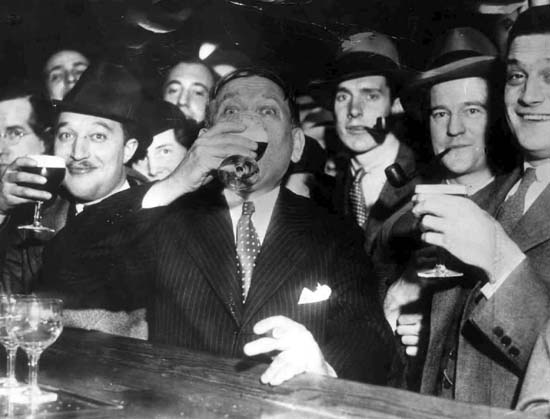
H.L. Mencken enjoys an Arrow beer at the Hotel Rennert in 1933, after Prohibition was repealed. Sydney Levyne, H.L. Mencken, Francis Jencks, McGill James, Hamilton Owens (L to R). ( Frank Miller / Baltimore Sun Photo )

By Frederick N. Rasmussen (The Baltimore Sun, 4/13/2009)

Thirty-three days after taking office, Congress fulfilled one of FDR’s campaign promises when the “wets” passed the Cullen-Harrison Act, which raised the alcohol allowed in “near beer” from 0.5 percent to 3.2 percent.

Maryland’s legislature wasted no time in taking advantage of the new law.

During its 1933 session, the legislature authorized the sale of beer in all counties except Caroline, Carroll and Garrett, “in each of which the same was made subject to a referendum,” according to the 1934 Maryland Manual.

On Thursday, April 6, 1933, which had been dubbed “New Beer’s Eve,” eager crowds gathered all over downtown Baltimore waiting for the moment when the hands of the clock crossed over to 12:01 a.m. Eastern Time – the exact moment when the Cullen-Harrison Act allowed the legal sale and consumption of beer in 19 states and the District of Columbia…

“Baltimore last night gave beer a gay and noisy welcome,” reported The Sun in its editions of April 7. “The downtown section was a Mardi Gras. Hundreds of horns, whistles, guns and small cannon shrieked and roared while the hands of `Big Sam’ — the City Hall clock — crept past midnight.”

At the appointed hour, whistles blew, and 100 beer trucks took to city streets in five minutes to deliver their cargoes of brew to slake the thirst of the faithful, The Sun reported.

Continue reading “Happy Belated New Beer’s Eve” at The Baltimore Sun.
Posted in 1930s, Beer, H.L. Mencken, Vices | Tagged | Leave a comment

The Rise and Fall of Prohibition in Baltimore, Maryland 1918-1933

Compiled by Michael T. Walsh, University of Maryland Baltimore County for the Maryland State Archives

H.L. Mencken enjoys an Arrow beer at the Hotel Rennert in 1933, after Prohibition was repealed.

The constitutional enactment of national prohibition in 1920 and its progressive aim of uplifting American society only lasted until 1933. Public opinion evolved in those thirteen years from supporting national prohibition to denouncing the attempt at legislating morals. Prohibition has generally been ridiculed in American history as a failure. No other state defines the failure of prohibition better than the State of Maryland from 1918-1933, especially in the defiant urban center of Baltimore.

Maryland was unique in its reactions to prohibition. It was the only state to never pass a state enforcement act, proudly labeling itself as a wet state. Prohibition in Maryland was seen as an infringement on states’ rights to enforce and control liquor traffic within its borders. Therefore, national prohibition would not be supported by the infringed upon state.

Between 1920 and 1933, the U.S. was legally a dry nation. Prohibition attempted to outlaw the manufacture and distribution of alcoholic and intoxicating beverages. Historians have generally agreed that those who led the prohibition movement were the middle-class reformers who were often the activists in the progressive movement. Since alcohol was deemed by these people to be one of the most prodigious evils that plagued the lives of Americans, the eradication of alcohol was initially a colossal victory.

Calls for temperance and prohibition existed before the United States was a nation. Paradoxically, Maryland is credited with starting the anti-liquor movement in 1642 when the colony punished drunkenness with a fine of 100 pounds of tobacco. The modern temperance movement had its roots firmly planted in the early- to-mid-nineteenth century. In 1826, the American Society for the Promotion of Temperance was organized in the city of Boston. Ironically, the Washington Temperance Society was formed in April 1840 at a tavern in Baltimore, Maryland by reformed drinkers. Repeated attempts to pass local and national prohibition laws were made during the mid-1800s through the early twentieth century.

Continue reading The Rise and Fall of Prohibition in Baltimore, Maryland 1918-1933.

Posted in 1910s, 1920s, 1930s, Booze, H.L. Mencken, Vices | Tagged | 1 Comment