Stickin’ It To The Man, Baltimore Style!

By Scott Carberry (Baltimore Boy, 3/29/2012)

“I was tooling around my old neighborhoods of Waverly and Charles Village today and came across a recently added traffic circle thingy at the intersection of 32nd Street and Guilford Avenue. Every time I see it, I realize that I’ve forgotten that Baltimore City, probably at the behest of the Charles Village Benefits District organization, put it there. I guess it’s a good idea. I lived in Charles Village forever and don’t recall there ever being a problem with traffic there. So who knows? I don’t think it’s a bad thing at all. Whatever, right?!

Skip to the loo, my darling! Get it?

Anyway, I see it, I note it, I go about my business on Greenmount Avenue. When I head back toward Charles Village proper, I drive on 32nd Street and when I come to the traffic circle, I see this!

Yes, that is a toilet. In the approximate 20 minutes between seeing it the first time and the return trip, west on 32nd Street; someone stuck a crapper on the traffic circle. Of course, I had to park the Honda and get out and snap some photos. Let’s look a little closer shall we?

Spent porcelain and cheap bubbly. Mmm.mm.. good!

Continue reading “Stickin’ It To The Man, Baltimore Style!” at Baltimore Boy.
Posted in Baltimorons, Charles Village | Leave a comment

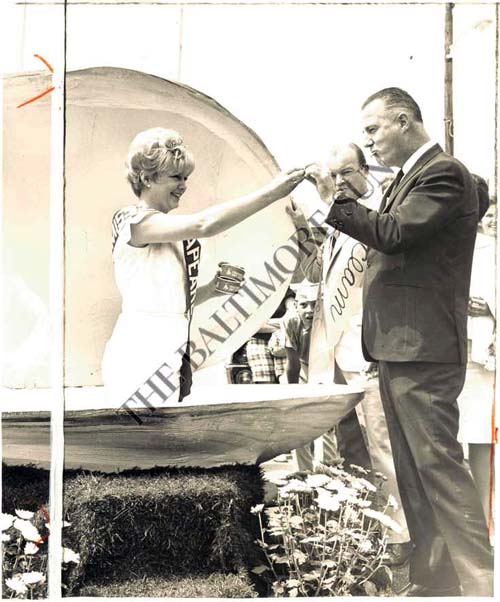
A Pearl Inside?

“A small boy peeps into a papier-mache clam for a look at what turns out to be Cindy Whitelock, who gives Governor Agnew a sample at Chesapeake Bay Soft Shell Clam Festival, Annapolis, Maryland, 1967.” Found on Ebay.com.

Posted in Baltimorons, Festivals, Politics | Tagged | Leave a comment

Wall Street Journal Soapbox: John Waters

The enigmatic auteur on his weird childhood, the sorry style of today’s rebels and the social importance of bad taste

By John Jurgensen (The Wall Street Journal, 3/29/2012)

GARDEN OF GOOD AND EVIL At 65, director John Waters is still impish, hilarious and subversive but has also mellowed a bit with age. Photograph by Adam Golfer.

John Waters, the writer and director who emerged from the midnight movie circuit of the 1970s, has earned his status as a social critic. In 13 feature films, including “Pink Flamingos” and “Hairspray,” he gleefully presents depraved characters undermining a society of squares.

In the seven years since he made his last film, the director has written “Role Models,” a collection of essays about his idols who hurdled over adversity, including Johnny Mathis, Little Richard and a seedy pornographer. He’s also hunting down funding for his next script, “Fruitcake,” a Christmas movie for kids. He lives in Baltimore, his native city and the setting for his films, in a house purchased in 1990.

At age 65, Waters remains a celebrated figure for counterculturists but accepts that his time as a revolutionary has passed. Earlier this year, protestors at Occupy Baltimore built an encampment they called Mortville, a tribute to the criminal enclave depicted in Waters’s film “Desperate Living.” Waters supports them but declined to join. “I have three homes and a summer rental, and some of my money is in Wall Street,” he explained. He champions younger filmmakers whom he says succeed in subversion, including Johnny Knoxville and Todd Phillips. At the same time, he reviles “the new bad taste,” which he defines as entertainment that tries too hard to shock and lacks inventiveness and wit.

“If your kid comes out of the bedroom and says he just shut down the government, he should have an outfit for that.”

Continue reading “John Waters” at The Wall Street Journal.

Posted in 2010s, Dreamlanders, John Waters | Leave a comment

What is an Alt-Weekly?

Judging City Paper and Life in Baltimore by 35 Years’s Worth of Each

by Lee Gardner (City Paper, March 28, 2012)

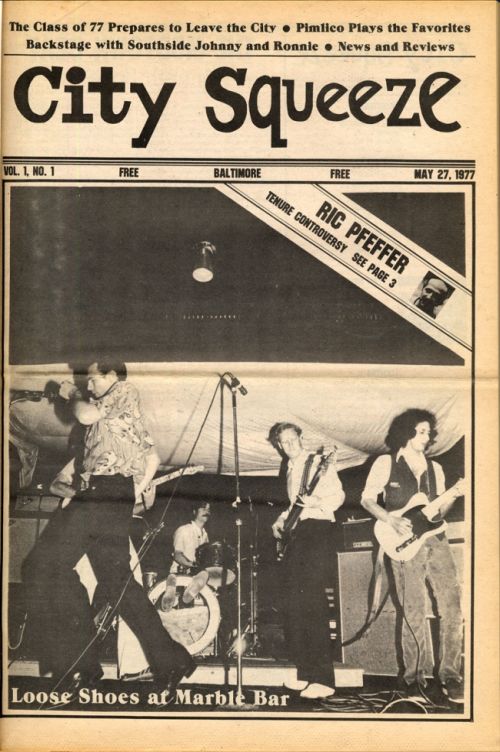
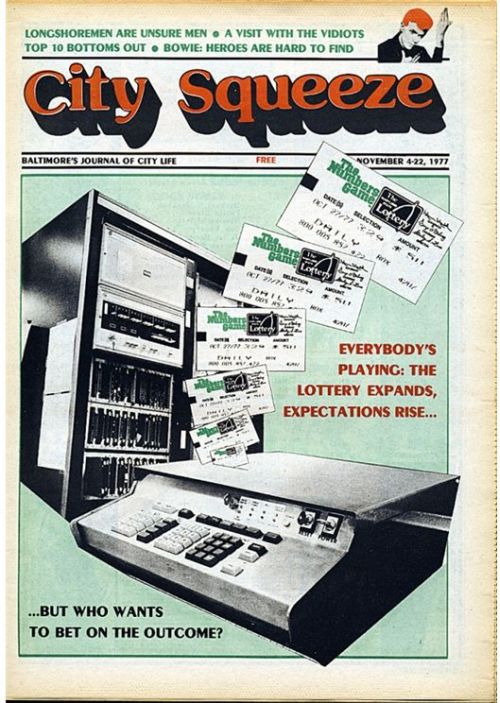
Perhaps the best tribute to a long-lived publication like City Paper would be a full-on Synecdoche, New York-style compendium of everything in every issue ever, all between one set of covers. (Or, you know, a complete run of 35 years’ worth of issues scanned in their entirety and available as PDFs online. Someday.) But flipping through old issues, it’s the covers that draw the eye. Each was (and remains) the print edition’s face to the world, announcing what the paper’s about, even if sometimes cryptically—the 1977 issue with nothing on the cover but a photograph of cheetahs stopped me cold mid-flip.

Thirty-five years of covers also serve as a sort of museum of publication design, as the black-and-white, blocky covers of CP’s earliest years gave way to spot color, then more elements, then fewer, then full color, then the telltale spidery fonts of early computer-assisted graphic design, and on up to the present. You can watch the elements ebb and flow: single images to multiple images and back, scant coverlines, as many coverlines as will fit, and everywhere in between.

Continue reading “What is an Alt-Weekly?” and view the cover gallery at City Paper.

Posted in 1970s, 1980s, 1990s, 2000s, 2010s, Decades, Entertainment, Media, Music | Tagged , , , , | Leave a comment