15 Baltimore Teams That Didn’t Make It
By Joe Platania (Press Box, 3-12-2012)
Baltimoreans are a practical lot. If you have a business of any kind that showcases consistency and success, the people here will support you for a long time.
The same is true with sports franchises. The Baltimore Grand Prix was well attended during its inaugural year, but had financial troubles, which led to the dissolution of Baltimore Racing Development’s contract with the city and a new agreement with Downforce Racing, which may salvage this event for the next few years.
But what about those teams that didn’t quite make it? Here is a list of some of the franchises that called Baltimore home for a short time … before time ran out, that is:
1. Baltimore Banners
The World Team Tennis franchise was one of the league’s charter members in 1974, but lasted just a half-season, despite the star power of legend Jimmy Connors, who was named one of only four WTT All-Time All-Stars. It was an experimental era for all sports; the 16-team WTT was born the same year as the ill-fated World Football League. The league is currently in its fourth incarnation.
2. Baltimore Claws
Briefly called the Hustlers, the American Basketball Association’s Claws came to town in 1975 in the wake of the troubles Memphis was having supporting its team. Two of its best-known players were big man Mel Daniels and Dunbar High legend Skip Wise, who was coming off a great freshman year at Clemson. Money troubles forced the team to fold after just three preseason games; players reported later that they were able to take some of the team’s furniture out of the Civic Center in lieu of paychecks.
3. Baltimore Metros
The Continental Basketball Association made several forays into this area, the first being a 1978-79 team that was so unstable in its management, it was practically a barnstorming outfit. This franchise began its existence as the Atlantic City Hi-Rollers. After stops in Washington D.C. and Baltimore, the Metros moved to Utica, N.Y., and became the Mohawk Valley Thunderbirds and then the Utica Olympics before folding in 1980.
4. Baltimore Bullets
No, it’s not the team you’re thinking of, the one that moved here from Chicago and played in the NBA from 1963-72 before moving to Washington and eventually becoming the Wizards. Nor is it the Bullets that won the 1948 NBA title. This bunch played in the old Baltimore Coliseum from 1958-61, making the Eastern Professional Basketball League finals in 1960 and winning the title the following year before moving to Camden, N.J.
5. Baltimore Lightning
The CBA gave it another go in this area with the birth of the Lightning, a team that played its home games in the Towson Center, at what was then called Towson State University, during the 1985-86 season. Money problems and a lack of fan support doomed the team, which had moved here from Lancaster, Pa., and eventually wound up in Rockford, Ill.
Continue reading “15 Short-Lived Baltimore Sports Experiments” at http://www.pressboxonline.com/story.cfm?id=8747.
See also:
Baltimore Hustlers/Claws @ http://www.remembertheaba.com/baltimore-claws.html
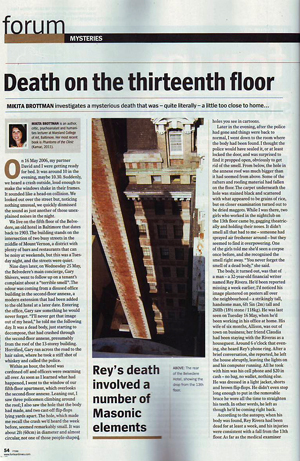 In this month’s issue of Fortean Times (#286), local author Mikita Brottman has an article involving the curious 2006 death of Rey Rivera, a 32 year old financial writer working for Agora called “Death on the thirteenth floor”.