Whatever Happened To Public Toilets?

On World Toilet Day the author asks: “How do you manage to enjoy a city if you’re constantly worrying about “holding it”?”

by Art Cohen (Baltimore Brew, 11/19/2010)

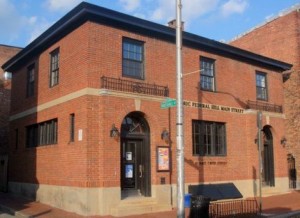
Vintage “comfort station” (ie public restroom) converted to a community visitors’ center by Historic Federal Hill Main Street. Photo by: Art Cohen, Baltimorebrew.com

“For some reason which is never clear to any foreigner, American cities tend to ignore one of the simple facts of nature.”

The need to urinate is what was being referenced delicately in this article about toilet availability, published in The Baltimore Evening Sun on January 2, 1941, on the eve of the arrival of 50,000 troops on their way to fight in World War II.

To accommodate the full bladders of an earlier wave of soldiers, during World War I, Baltimore churches had opened their toilet facilities to members of the public needing restrooms. In 1942, the City’s Advisory Engineers recommended that the City Plan Commission add seven additional public toilets (referred to as “comfort stations”) to the nine that had been constructed in or near Baltimore markets between 1907 and 1929.

Continue reading “Whatever Happened To Public Toilets?” at Baltimore Brew.

Posted in Roadside Attractions | Tagged , , | Leave a comment

Former Burlesque Dancer Reminisces

Ex-Stripper’s Days Are Now Quiet Ones

By Rafael Alvarez (The Baltimore Sun, 2/2/1993)

It isn’t right for Jean Honus to be all alone on Barney Street.

The house is quiet; hours are long.

And there’s no action.

Not like the days when men gave her diamond watches just because they liked the way she moved.

When strangers by the hundreds whooped and hollered and whistled as she sashayed her knockout figure across a stage.

Back when Jean Honus did the striptease on Baltimore’s Block in the glory days of burlesque.

The theaters and musicians, the bookies, the barkers, the wise guys, the prizefighters and the straight men, all gone.

At age 74, the woman born to a coal-mining family in Shenandoah, Pa., accepts that time has reduced the art of burlesque to stark nudity and robot music.

But it’s not right, she says, that she outlived almost all of her friends from her burlesque days.

“I’m very lonely,” says Miss Honus, cooking up a big pot of rigatoni and hot sausage, grateful for the chance to entertain a new visitor to her South Baltimore rowhouse, eager to fill a fresh ear with her stories. “I go out every day now and sit with friends, but people don’t want to hear too much of your troubles. You try to hide from loneliness, but it’s so hard. I don’t know what to do with myself so I just get up and get out of here. I go down to the market even if I don’t have to buy anything.”

Fast living and hard liquor, she says, killed most of her colleagues years ago.

“I have no friends because they drank themselves to death,” she says, tears coming to her eyes. “Drink ruined my girlfriends, girls that should be here today with me. I took care of myself and I’m here. They drank morning, noon and night — they thought they were having fun, but they weren’t happy. Sometimes I’d take two days off from work just not to drink, to get some sleep and take care of myself. I had a lot of fun, but it all just came and went.”

Continue reading “Former Burlesque Dancer Reminisces” at The Baltimore Sun.

(Note: Jean Honus passed away on April 18th, 1998)

Posted in "The Block", 1990s, Booze, Burlesque, Nightlife, Strip Clubs, Vices | Tagged , | Leave a comment

RIP Dale Coleman: Rock Guitarist Would Set His Arms On Fire


Tommy Carson (left) singing with Dale Coleman (right)

Dale Coleman Sr., Age 62
The 1960s and 1970s rock guitarist devised a concert finale in which he would set his arms on fire.

By Jacques Kelly (Baltimore Sun, 2/14/2007)

Dale Coleman Sr., a 1960s and 1970s rock guitarist who created an act where he set his arms on fire, died Friday of Crohn’s disease at Bon Secours Hospital. The Loch Raven Village resident was 62.

“He was one of the greatest guitar players I was ever associated with,” said band leader Tom Stauch of Abingdon, better known as Tommy Vann. “He patterned himself after Jimi Hendrix, but Dale was always distinct and unique. Long before Hendrix, he was doing wild things with the guitar.”

Born in Baltimore and raised in Timonium, Mr. Coleman began playing music while attending Dulaney High School. He also studied music composition for two years at the Peabody Conservatory.

Mr. Coleman began appearing at high school fraternity dances at the old Gwynn Oak’s Park Dixie Ballroom.

“Every night seemed to end in a fight, and the mirrors at one side of the building got broken,” said a brother, Chris Coleman of Sparks.

The rock bands Mr. Coleman joined performed at Baltimore County nightspots, including Christopher’s in Timonium, Satyr House and Club Venus, both on Joppa Road, and Latin Casino in Essex. Friends said he established a following as he played.

“He had a bigger-than-life personality. He was a Hollywood kind of person who never made it to Hollywood,” said Joe Baranoski, who heard him play nearly 35 years ago. “His music was incredible — he played the music of the times — Led Zeppelin, Hendrix and Grand Funk Railroad — and he added his own flair to it.”

Mr. Coleman bought a Gibson Firebird guitar and could play it with his teeth — or behind his back.

“I saw him sleep with that guitar,” said Tom Carson, a friend who sang with The Fugitives. “He was a wild man, an innovator, who played with long, bony fingers. He was one of a kind, a master of the guitar.”

Mr. Coleman played with The Fugitives, Charades, Tommy Vann and the Professionals, and Expressway, which traveled with the Edgar Winter Group and was a warm-up act for Aerosmith concerts. His guitar playing is heard on the 1968 Tommy Vann recording of Soul Sister Annie on Capital Records.

“I’m just one of those people that has to move around when I’m playing,” he told an Evening Sun reporter in 1974 when describing his stage personality.

As music changed in the 1970s, Mr. Coleman added electronic instrumentation to his performances, including the wah-wah pedal. He also sang and played harmonica in a style reminiscent of Bob Dylan.

Mr. Coleman added pyrotechnics, consulting with a chemist and a friend who taught high school science. They created a combustible mixture of mutton tallow and petroleum distillate.

“When I’m going that route, I soak my arms in alum and cold cream for a couple hours,” Mr. Coleman said in the 1974 interview, adding that he had had only a minor burn in 50 finales to his act — when he would set his arms on fire as he played.

Mr. Coleman was diagnosed with Crohn’s disease in 1979. He later became disabled and retired from music.

He worked in the Charles Street jewelry shop owned by his father, Nelson Coleman Sr., in the basement of the Woman’s Industrial Exchange building. He became a salesman and estate jewelry buyer before moving into a nursing home because of the illness. He entertained fellow patients on his guitar for the past two years.

Mr. Coleman’s only child, Dale Coleman Jr. of Parkville, is also a rock guitarist and appears with Pure Gold, Unveiled and the Dale Coleman Duo.

A memorial services will be held at 1 p.m. tomorrow at the Ruck Towson Funeral Home, 1050 York Road.

In addition to his brother and son, survivors include his mother, Virginia Doederlein Coleman of Towson, and three other brothers, Mark Coleman of Bel Air, Randy Coleman of Alexandria, Va., and Jeffrey Coleman of Baltimore. His marriage to the former Georgia Blevins ended in divorce.

Posted in Baltimorons, Nightspots, Obituaries | Leave a comment

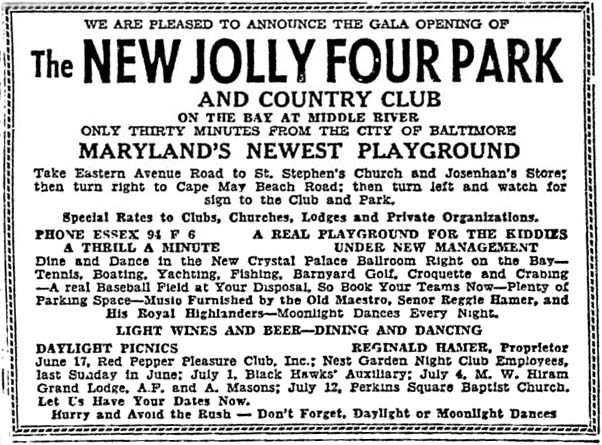
Jolly Four Park: Essex’s Secret African-American 1930s Nightclub

Baltimore Afro-American ad, 6/30/1934

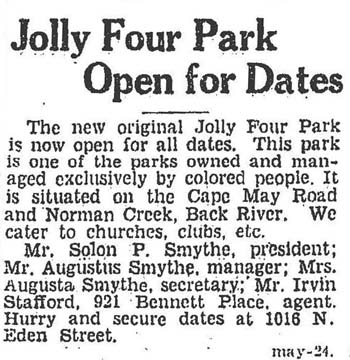
One of those Essex urban legends that my late mother Jackie Nickel was never able to verify concerned the existence of a secret African-American speakeasy/nightclub/picnic pavilion/swim club off of Back River Neck Road in Essex. There’s the remnants of a gravel road with a chain linked across it leading to dense woods. But no remnants of a nightclub or picnic pavilions or anything to suggest that this was once an exclusively black summer getaway in Essex. I’ve searched newspaper archives for years and finally got lucky searching the Afro-American. It existed — The Jolly Four Park! Other than ads there are no mentions other than a report of a drowning that occurred during a Fourth of July weekend. And considering that it was the 1930s in Essex, that drowning may have been somewhat suspicious…

Baltimore Afro-American ad, 5/24/1930

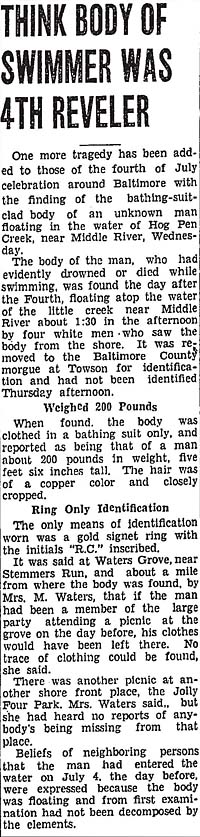
THINK BODY OF SWIMMER WAS 4TH REVELER

(Baltimore Afro-American, 7/15/1933)

One more tragedy has been added to those the fourth of July celebration around Baltimore with the finding of the bathing-suit-clad body of an unknown man floating in the water of Hog Pen Creek, near Middle River, Wednesday.

The body of the man, who had evidently drowned or died while swimming, was found the day after the Fourth, floating atop the water of the little creek near Middle River about 1:30 the afternoon by four white men who saw the body from the shore. It was removed to the Baltimore County morgue at Towson for identification and had not been identified Thursday afternoon.

Weighed 200 Pounds

When found, the body was clothed in a bathing suit only, and reported as being that of a man about 200 pounds in weight, five feet six inches tall. The hair was of a copper color and closely cropped.

Ring Only Identification

The only means of identification worn was a gold signet ring with the initials “R.C.” inscribed.

It was said at Waters Grove, near Stemmers Run, and about a mile from where the body was found, by Mrs. M. Waters, that if the man had been a member of the large party attending a picnic at the grove on the day before, his clothes would have been left there. No trace of clothing could be found, she said.

There was another picnic at another shore front place, the Jolly Four Park, Mrs. Waters said but she had heard no reports of anybody’s being missing from that place.

Beliefs of neighboring persons that the man had entered the water on July 4, the day before, were expressed because the body was floating and from first examination had not been decomposed by the elements.

Posted in 1930s, Deaths, Essex / Middle River, Roadside Attractions, Vices | Tagged , , , | Leave a comment