“In this banner taken from SUBWAY restaurants official website you can see that the steam ascending from the sandwich spells SEX. The word SEX is also etched several times on the sandwich and on Phelps’ body.”
Jerry Casale, Devo guitarist and chief spokesman, paused between bites of a shrimp cocktail and sips of white wine in the dining room of the Pikesville Holiday Inn to ponder the question: How did the group begin wearing the yellow nylon space suits that have come to be one of Devo’s principal trademarks?
“Well,” Casale began with a perfect deadpan, “always being conscious of the latest fashion…”
Jerry Casale dined on a shrimp cocktail much like this one in the dining room of the Pikesville Holiday Inn.
Welcome to the wacky world of Devo, the latest swell in the waves of new wave bands, encountered on this night before its sold-out performance at Painter’s Mill Music Fair the Friday before New Year’s.
Devo generates a large dose of power pop and is sparked by more than a touch of pure put-on. Though Devo’s music is not without a message, the group generally comes off of as a kind of rock equivalent of “Saturday Night Live’s” Not Ready For Prime Time Players, with its manic energy and bent for satirization.
Even the group’s name, which members say is short for de-evolution, and music, which they describe as the sound of things falling apart, contain a suggestion of parody.
Old movies
And there is the group’s show. It begins with a brief movie of old footage of dancing fans with Devo singing “Come Back Jonee” in an effective lampooning of rock idolatry. It then moves to Devo’s staccato remake of the Rolling Stones’ “(I Can’t Get No) Satisfaction” and ends with the group singing “Jocko Homo,” with the catechism, “Q: Are We Not Men? A: We Are – Devo,” which is the title of their debut LP, to a room full of people in surgical masks and gowns.
At the end of the movie, the five-member group — three guitarists, a drummer – and a synthesizer — appear on stage. shouting “We are Devo!,” jerking around as if they had boards strapped to their backs and snapping their heads sideways on every backbeat.
After running through songs like “Praying Hands,” “Uncontrollable Urge” and “Mongoloid” that form the core of their lament against the strictures of industrial society, they break into a live version of “Jocko Homo.” Halfway through the number, they rip off their nylon space suits and toss them to the audience, an apparent satirization of Elvis Presley’s habit of tossing scarves to his fans. They finish the performance in black underclothes with matching red shin’ and elbow guards and red helmets, looking like some strange clones of Gestapo storm troopers.
Casale and Mark Mothersbaugh, synthesizer and vocalist — who, like the others in the group, are natives of the Akron (Ohio) area — began putting their show — and music together at Kent State University in the early Seventies, where both had gone to study art. They became fans of, among others, John Waters, Baltimore underground filmmaker.
“Our influences were less strictly musical than other bands,” Mothersbaugh explained. “We were probably influenced more by Ronald McDonald and John Waters than by Mick Jagger and Eric Clapton.”
What makes Devo run
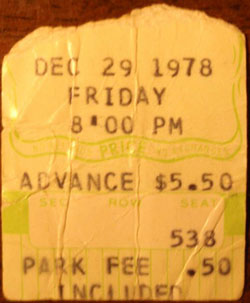
Painter’s Mill concert stub from Huboon.com’s Devo Live Guide
Indeed, what Casale says about Waters may give more of a clue to what Devo is all about than anything he says about the group’s music. Casale says he is particularly drawn to the way Waters “deals with serious things on a nightmare, surreal level. As with Waters, Devo works from the imagination.”
What comes out is not without merit. The opening guitar runs on “Uncontrollable Urge” and “Mongoloid” show some real musical talent. And “Shrivel-Up,” which closes their album, may contain one of the best two-line summaries of the hew-to-the-line philosophy of the Seventies: “It’s at the top of the list/That you can’t get pissed.”
Devo’s remake of the Stones’ “Satisfaction” is also worthy of note for reasons that have nothing to do with the kinky effectiveness of the interpretation. For one thing, it serves to separate the group from such punk rockers as Johnny Rotten. who has criticized Jagger for becoming too fat in his ways and too soft in his music. For another, it points up the group’s elemental perception of the world. “Here it is almost 1980,” Casale says, “and you still can’t get no satisfaction.”
Yet at other times the group seems fascinated by its ability to produce lyrics that are nonsensical, as in “Jocko Homo,” and sounds that are so over-synthesized they cease to be music. The latter is the case on “Too Much Paranoias” (sic), which contains some of Devo’s best lyrics but sounds like it was made to be the soundtrack for Star Wars II.
That, coupled with the strange attire and onstage antics, inevitably inspire the suggestion that Devo is strictly a gimmick group that shouldn’t be taken seriously, despite increasing attention that includes a highly successful European tour, a recent appearance on “Saturday Night Live” and mention in People magazine’s 1978 year-end issue.
Don’t want MOR
“Actually, I wish people would regard Aerosmith as tongue-in-cheek,” Casale said. “Why they don’t point up what’s happening. All the Seventies are is a bunch of people who have lost it and stayed around. MOR [middle-of-the-road music] is the big sleep of the Seventies.
“We got to the point where we couldn’t stand the music that was being made so we decided to throw our hat into the ring, We took the attitude that what we were doing was legitimate and we would put it out there.
“We are the band that does the things that haven’t been done before — in music and in our stage shows. There’s something in our music that strikes a level in people they connect with.”
Asked what that level was, Casale paused between another bite of his shrimp cocktail and sip of white wine to ponder the question.
Jockey Club hopes Preakness 2011 will ‘Be Legendary’
By Matt Vensel (The Baltimore Sun, 3/29/2011)
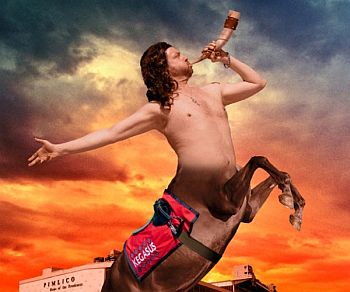
A year after the Maryland Jockey Club encouraged Baltimore to get its “Preak” on with a feather-ruffling advertising campaign for last year’s Preakness party, event organizers are turning to a spokes-centaur named “Kegasus” to generate interest in the 2011 Preakness InfieldFest, which is May 21 at Pimlico Race Course.
The Maryland Jockey Club announced today in a press release the launch of this year’s InfieldFest campaign, “The Legend of Kegasus,” which centers on a mythical creature that is half-horse and half-man — and a full-on “party manimal,” according to the release. Kegasus will be the voice of the campaign in all advertisements for television, radio and on the Internet, including YouTube and Twitter (www.twitter.com/allhailkegasus).
“In order to reach our highly targeted younger demographic, we have realized we need to go where they go and do what they do,” MJC president Tom Chuckas said in the release. “By launching a robust social media presence and appearing at downtown bars, Kegasus will have the opportunity to interact directly with his fans and get them excited about this year’s InfieldFest.”
Because nothing gets horse racing fans and party-goers excited like a shirtless guy in half of a horse costume.
Continue reading “Jockey Club hopes Preakness 2011 will ‘Be Legendary'” at The Baltimore Sun.
Putting A New, Strange Face On Preakness
The choice of ‘Kegasus,’ a partying centaur, as the mascot for the race raises eyebrows — and questions
By Jill Rosen (The Baltimore Sun, 3/29/2011)
Half-man, half-horse and altogether drunk, the Preakness’ newest pitchman, introduced Tuesday, is a “party manimal” with one job: reassuring young people that this year’s infield festivities will indeed be rowdy, raunchy and booze-soaked.
Kegasus, a centaur with a nipple ring, body hair and ample beer gut, is the centerpiece of the new ad campaign for Maryland’s leg of the Triple Crown. Starting this week, he’ll be spreading his hard-partying message on television, radio and social media outlets that cater to the 21- to 40-year-olds the race hopes to reach.
Only hours old, the campaign was already garnering criticism Tuesday for being tasteless and encouraging binge drinking. Jason Loviglio, director of media and communications studies at the University of Maryland, Baltimore County, declared it “awful,” “depressing” and “sad,” but also predicted it would be quite effective.
“If the goal is to let them know they will be able to drink to excess, it does communicate that,” he said. “If there’s confusion about whether they’ll be able to pursue sunstroke and alcohol poisoning, seeing this, it’s clear indication that yes, they will.”
Continue reading “Putting A New, Strange Face On Preakness'” at The Baltimore Sun.
Kegasus Press Release
MARYLAND JOCKEY CLUB LAUNCHES 2011 INFIELDFEST ADVERTISING CAMPAIGN
MJC urges fans to “Be Legendary” at Preakness InfieldFest
Baltimore, MD (Tuesday, March 29, 2011) —The Maryland Jockey Club (MJC) today launched the 2011 Preakness InfieldFest campaign, “The Legend of Kegasus”. Kegasus is the Lord of the InfieldFest and a modern twist on a mythical centaur. Serving as the voice and personality for all advertisements, Kegasus can be found in all of the campaign’s components to include television, radio, out-of-home and web.
“We are excited to be launching this campaign and look forward to watching this image grow throughout the course of its eight-week run,” Tom Chuckas, Maryland Jockey Club president said. “Kegasus speaks directly to our InfieldFest demographic with his no-nonsense personality and total embodiment of a good time.”
The 136th running of the $1 million Preakness® Stakes (Grade I), the middle jewel of the Triple Crown, is May 21 at Pimlico Race Course.
The InfieldFest party at The Preakness Stakes is legendary and continues to grow. The Maryland Jockey Club aims to spark added interest by empowering a legendary centaur – half horse, half man – as the campaign’s spokesperson. The humorous nature of the advertisements and their inclusive message are just two of the many added bonuses.
The MJC also anticipates this party “manimal” to come to life outside of traditional media. Kegasus will be appearing at various grassroots events around Baltimore leading up to the Preakness. He will be making his in-person debut at pregame festivities for the Baltimore Orioles home opener on Monday, April 4. He will also be posting web videos to his own YouTube channel, and yes, Kegasus even tweets.
“In order to reach our highly targeted younger demographic, we have realized we need to go where they go and do what they do,” Chuckas added. “By launching a robust social media presence and appearing at downtown bars, Kegasus will have the opportunity to interact directly with his fans and get them excited about this year’s InfieldFest – the premier celebration in the Mid-Atlantic region.”
Earlier this month it was announced that Grammy Award Winning artists Bruno Mars and Train were to headline the InfieldFest concert, with Phil Vassar, Puddle of Mudd and local favorites Mr. Greengenes on the Jägermeister stage. The popular MUG Club returns, offering fans a bottomless mug all day long for one all-inclusive price.
For the second consecutive year, the MJC has tapped Elevation, Ltd. to develop and execute its InfieldFest advertising campaign. “We are honored to once again work hand-in-hand with the Maryland Jockey Club to create a campaign that galvanizes our target audience and brings excitement to this legendary event,” Jim Learned, president of Elevation said.
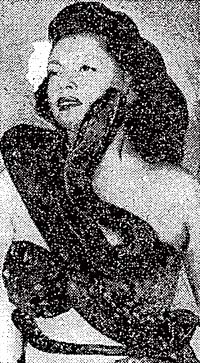
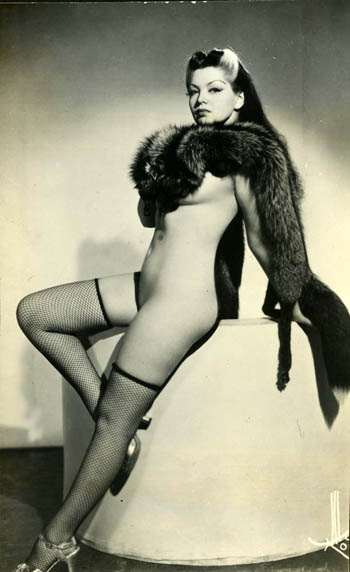
ZORITA AND THE PRINCE: The Prince, she said, was bewitched. But the cops weren’t.
Greek mythology was set back to the tune of $40 in the classic interior of Central Police Court yesterday where an East Baltimore street snake dancer was dressed down by the law for writhing ungarbed in the eyes of snake, public and police.
Facing charges of giving an in-decent performance with her 7-foot reptile on the floor of the Two O’Clock Club runway Saturday night, “Zorita” denied her act was salacious.
Old Legend, He Avers
In fact, maintained her lawyer, the dance was worked up, after considerable research into Greek mythology, to interpret an old Hellenic legend.
Strictly art, eh? mused Magistrate William F. Laukaitis. Could the mythology student refer him to the legend she was interpreting when the cops cried, “Stop!”
“Zorita” obliged with the fable of a young princess and her prince. In her act, she said, she represented the princess dancing with the prince who had been bewitched and transformed into a snake.
Mythology Turns Rusty
Magistrate Laukaitis asked if she could tell him more of this myth.
“Zorita” admitted she could not.
She was a little rusty on her mythology, she said.
A disciple of Terpsichore, muse of the dance, “Zorita” was reaching the climax of her Saturday night show when she offended legal definitions of good taste, said Sergt. Joseph Byrne.
Seated with three other plain-clothes policemen at the bar, Sergeant Byrne noticed the offense, he said, when part of her costume loosened.
He Leaps—And Shouts
He immediately leaped up and shouted, “Stop!”
“I thought it was some jerk in the audience,” explained the mythology student. “So I went on and finished my act and took my bows.”
As for the loosened garment, “Zorita” was outspoken: “The cops claim my costume was loose.” Gingerly rubbing her flanks, she commented, “I don’t see how it could have been any tighter.”
Magistrate Laukaitis gingerly rubbed his chin.
Quickly, “Zorita” added, “The cops must have had x-ray eyes to be able to see—what they claim they saw.”
“Zorita” was garbed in a black fishnet-type of garment that hung about her like old window drapes, Sergeant Byrne testified.
During the climax of her act, the netting was slipped aside to allow closer proximity between artist and snake, Sergeant Byrne said.
And The Eyes Have It
As the snake nestled closer—and closer—and closer—the sergeant’s eyes grew wider—and wider—and wider.
The sergeant’s shock came as something of i surprise to her, “Zorita” said, because she once “gave the same act before the Chicago Policemen’s Benevolent Association.”
“And they thought it was wonderful!”
Magistrate Laukaitis levied fines totaling $40 and costs on “Zorita,” who gave her name as Mrs. Ada Petillo and her age as 28.
“It’s possible,” the magistrate said, “that she might have over done it a little at the end of the act
“You know how it is—with all that applause from the crowd.”
“Zorita” was only one of three night-club dancers, arrested Saturday by Sergeant Byrne on indecent-performance charges.
The other two. arrested in the Bettye Mills Club, were dismissed for lack of evidence that they exposed more than the city fathers allow.
Sergeant Byrne testified “both had bumped too much” and “there were too many grinds.” He added that both also were “making suggestive motions with their hips and rolling their eyes in suggestive fashion.”
Replied one: “I can hardly move my eyes. How could I roll ’em?”
No Rule, They Say
Lawyers for the dancers argued that there was no definite rule in Baltimore by which a dancer can tell when she has exceeded the legal number of “bumps and grinds.”
There followed a conference before the magistrate’s desk among Magistrate Laukaitis, the attorneys and the police.
At its conclusion, it was suggested that Sergeant Byrne and his men make an investigative tour of all clubs in “The Block” to see what the general practice is among strippers. “I think that,” said Sergeant Byrne. “is a good idea.”