By Robert Christgau and Carola Dibbell (Oui, 5/1975)
“Eighty percent of the beer in this country is consumed by 20 percent of the drinkers. That’s why the most effective beer slogan ever conceived claims that its product is the best beer to have when you’re having more than one. Oui’s consumer guide to beer, presented herewith, has been devised for the 80 percent of American beer drinkers who care about that first one.”
NATIONAL BOHEMIAN LIGHT BEER
(Baltimore, Maryland)
It definitely does not let down the good family name. It’s clean and pleasant but not innocuous, with a slightly penetrating aftertaste. It generally placed high on taste tests, to discriminating judges and against stiff competition. We unfairly continue to measure it against the premium. B
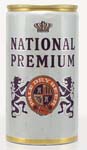
NATIONAL PREMIUM
(Baltimore, Maryland)
For some time, we were convinced that this European-slanted beer with the conglomerate name and the water from Baltimore’s city water system was the best in America. National Premium not only scored consistently well against all American premiums, it held its own in blindfold tests against the best European labels. Dry, pleasurable to contemplate–particulary at warmer temperatures–with distinctive but not weirdo minty bitterness, and very clean and light, National Premium seemed to offer the best aspects of both European and American beer. We’d still like to think that’s true. But alas, after our free samples ran out, the bottles we bought in the real world (from our local supermarket) were so stale and inferior that we felt compelled to qualify our judgment. A MINUS
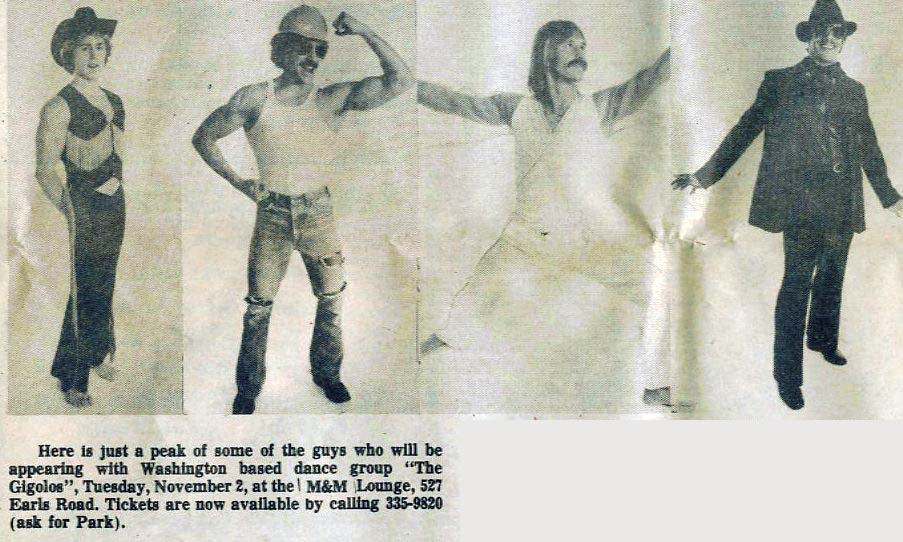
Two are obviously Village People, but who is the third guy? Doug Henning? And the last guy, is he some sort of 80s mafioso? Please submit your guesses.
Executive producer Anya Epstein explains why the city crops up in the series so often
by David Zurawik, The Baltimore Sun, 11/19/2010
For a TV series neither set nor filmed in Baltimore, the city sure plays a prominent role in the Peabody Award-winning HBO drama “In Treatment.” And the off-camera roots of the program about the work and life of a brooding, emotionally wounded psychoanalyst run even deeper into Charm City soil, according to executive producer Anya Epstein.
Paul Weston, the Brooklyn, N.Y.-based therapist played by Gabriel Byrne who is at the heart of the series, is constantly referring to Baltimore.
He lived and worked in the city in the first season. His ex-wife (Michelle Forbes) and one of his children remain there — as does his mentor and former therapist, Gina Toll (Dianne Wiest). He and Gina met at the fictional Baltimore-Washington Psychoanalytic Institute, where she was on the faculty. And last season after moving to New York, he traveled to Baltimore from Brooklyn once a week for his sessions with Gina.
Continue reading “In Treatment is steeped in Baltimore references” at baltimoresun.com.
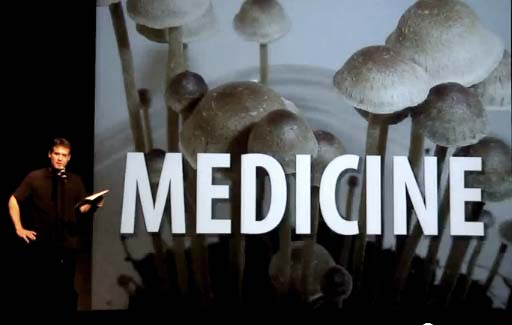
Baltimore author Michael M. Hughes recently presented his talk on the history of magic mushrooms and their active ingredient, psilocybin for the Ignite Baltimore lecture series, sharing interesting and not-so-well-known information from ancient history, popular culture, and cutting edge neuroscience. Michael previously wrote a Baltimore City Paper cover story on the Johns Hopkins Psilocybin Studies – “a rigorous, scientific attempt to determine if drugs like psilocybin and LSD, demonized and driven underground for more than three decades, can facilitate life-changing, transformative mystical experiences.”
“…Tonight we’re going to talk about the most magical mushrooms of all, of the genus Psilocybe, which contain the psychoactive compounds psilocybin and psilocin. They are found on every continent except Antarctica and nearly every climate, frequently following human activity, growing in disturbed soil and the manure of our cattle. Because of their unique ability to alter human consciousness, they are often considered sacred or even gods in their own right.”
Continue reading “Teonanácatl: The Secret History of Magic Mushrooms” at michaelmhughes.com.
Mike Hughes’ video presentation of “Teonanácatl” for Ignite Baltimore.
Sacred Intentions: Inside The Johns Hopkins Psilocybin Studies
By Michael M. Hughes, Baltimore City Paper, 10/8/2008
Sandy Lundahl lies on a couch, her eyes covered with a dark cloth mask. She’s listening to classical music through enormous headphones: Brahms’ Symphony No. 2, the “Kyrie” from Bach’s Mass in B Minor, Barber’s Adagio for Strings. An hour earlier, she had swallowed two blue capsules containing close to 30 milligrams of psilocybin, the primary active chemical in Psilocybe cubensis and other “magic” mushrooms, and she’s already well on her way on a trip into the hidden spaces of her psyche.
Lundahl, a 55-year-old self-described skeptic and health educator from Bowie, is looking for God.
Two experienced guides are with her in the room, monitoring her: Mary Cosimano, a clinical social worker, and William “Bill” Richards, a white-haired, 68-year-old psychiatrist and scholar of comparative religion. He’s sitting cross-legged on the carpet in front of the couch, ready to help Lundahl–to talk her out of any negative trips, to help her remain focused on the scenes unfolding behind the mask, to offer a drink or some fruit or escort her to the bathroom. The space resembles a clean, warm, but decidedly offbeat living room. The lighting is spare and soft, emanating from two lamps. A bookshelf holds a variety of picture books and well-known spiritual and psychological classics like Freud’s The Interpretation of Dreams and The Varieties of Religious Experience by William James. Above the books sits a wooden sculpture of Psilocybe mushrooms. Behind the couch are a Mesoamerican mushroom stone replica and a statue of a serene, seated Buddha. An eye-popping abstract expressionist painting hangs on the wall, an explosion of color and intersecting lines.
This isn’t a metaphysical retreat center in San Francisco, or the Manhattan office of a New Age therapist-cum-shaman. Lundahl’s first psychedelic experience is taking place in the heart of the Behavioral Biology Research Center building at the Johns Hopkins Bayview campus in Southeast Baltimore, in a room affectionately referred to by both the scientists and the volunteers as the “psilocybin room.” She’s taking part in the first study of its kind since the early ’70s–a rigorous, scientific attempt to determine if drugs like psilocybin and LSD, demonized and driven underground for more than three decades, can facilitate life-changing, transformative mystical experiences.
Continue reading “Sacred Intentions: Inside The Johns Hopkins Psilocybin Studies” at Baltimore City Paper.
 NATIONAL BOHEMIAN LIGHT BEER
  NATIONAL PREMIUM