Atomic TV visits Baltimore’s Great Blacks in Wax Museum

Black History Month Classics:
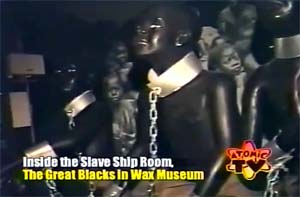
Atomic TV’s 2003 Visit to Baltimore’s Great Blacks in Wax Museum
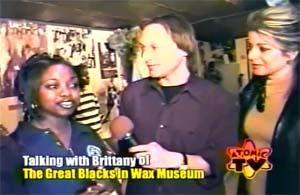
Tom Warner and Kelly Conway interview a staff member from the Blacks in Wax Museum.


Atomic TV visits Baltimore’s Great Blacks in Wax Museum from Atomic TV on Vimeo.
Atomic TV’s Tribute to Black History
“Once you go Black, you never go back! Case in point, Atomic TV went black on Baltimore’s public access airwaves shortly after broadcasting our legendary “Black History Month” tribute – one of our most popular episodes ever! – in February 2003. Over the course of the next 2 hours, you’ll see shout-outs not just to the usual legends on display at Baltimore’s Great Blacks in Wax Museum, but also to leaders in other less-heralded fields of Black achievement – like Black Porn Stars – Jack Napier the “The Joker with the Foot-Long Poker,”, Menage-a-Trois and her foot-long tongue, Sierra, Chaos, Marc 9X7, Nikki Fairchild, Sean Michaels – and Rappers who Glorify Da Booty, plus Blaxploitation stars Rudy Ray Moore (Dolemite!), Pam Grier and Isaac “Truck Turner” Hayes, Mr. T., Blowfly, sideshow freak “Popeye,” Pee-Wee Herman’s “King of Cartoons,” William Marshall and a special shout-out to Bawlmer’s Eldorado Lounge – the place that inspired us to create Atomic TV back in 1997. So get funky with it and check it out, yo!”

[wpgmza id=”4″]
Posted in Atomic TV | Tagged , , , , , , | Leave a comment

You are listening to Baltimore.

http://youarelistening.to/baltimore > Click to Listen

Live Baltimore police radio mixed with ambient music. Utterly fascinating…

Posted in Crime, Music | Leave a comment

Underdog Marches for Martin Luther King, Jr.

Black History Month Classics:
Suzanne Muldowney Joins the 2003 Martin Luther King Day, Jr. Parade

“When the Negro was completely an Underdog, he needed white spokesmen. Liberals played their parts in this period exceedingly well…. But now that the Negro has rejected his role as an Underdog, he has become more assertive in his search for identity and group solidarity; he wants to speak for himself.”
Martin Luther King, Jr., “Where Do We Go from Here: Chaos or Community?,” 1967

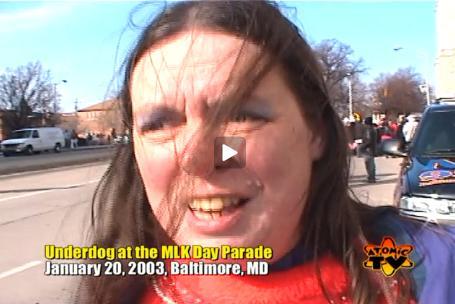
This historic event in Baltimore yore took place eight years ago. On January 20, 2003, more than six weeks after she appeared in the Mayor’s Annual Christmas Parade as 1960s cartoon superhero “Underdog” — Suzanne Muldowney returned to Baltimore to partake in her first and only Martin Luther King, Jr. Day Parade. There she was greeted by Atomic TV‘s Tom Warner and Scott Huffines, who recorded her historic appearance for posterity.

Muldowney had petitioned the organizers to let her march in the parade because she believes that Underdog has a strong connection to Dr. Martin Luther King, Jr., with both folk heroes coming to national prominance in 1964. Not only was 1964 the year Underdog debuted on Saturday morning television, it also marked the historic passage of the Civil Rights Voting Act, and was the year that Dr. King marched from Selma to Montgomery, Alabama, and received the Nobel Peace Prize.

Though there were no characters of color on the ’60s TV cartoon show, when it came to thwarting injustice, Underdog was a colorblind canine superhero; he aided anyone in need – regardless of race, color, or creed.

It was a bitterly cold and windy day for a parade, with sub-freezing temperatures in the teens, but if Dr. King could make the long march from Selma to Montgomery, surely Muldowney’s iconic canine superhero could brave a few hours of a Charm City cold snap to march down Martin Luther King. Jr. Boulevard from Eutaw to Baltimore Street.

Posted in 2000s, Atomic TV, Baltimorons, Black History, Festivals, Holidays, Neighborhoods, Roadside Attractions, Television, Urban Legends | Tagged , , , , , , , | Leave a comment

Baltimore… is America’s Next Great Underdog City

79 Things We Can All Agree On
There are plenty of things to fight about, but look at how many things we see eye to eye on

(Esquire Mazgazine, 2/7/2012)

Photo by David Zimmerman, Getty

Baltimore… is America’s next great underdog city, now that New Orleans is (sort of) back on track. They feel weirdly the same as you walk around them today, these twin objects of David Simon’s obsession: pockets of vibrancy surrounded by stretches of ruin; an overarching sense of police and political corruption; humid enough in the summer to melt your pants; a delicious selection of seafood pulled from polluted waters. Whether you prefer Baltimore or New Orleans really comes down to whether you prefer crab dip or crawfish, The Wire or Treme.

The difference is nobody talks about Baltimore and its particular brand of suffering. It has absorbed slight after slight for years, taking them like gut punches, because what else was it going to do? Its current mayor took over after the last one resigned in the wake of embezzlement and perjury charges. Local police statistics have been cast repeatedly into doubt, so no one knows if violent crime is down or up or by how much. It is indisputably three hundred thousand citizens smaller than its peak. It does not have professional basketball or hockey teams, and its baseball team is only marginally professional.

But because its death spiral has been slow — unlike Katrina’s short, sharp leveling of New Orleans — it has continued virtually unnoticed by the rest of the country. Even Newark gets more attention. Which Baltimoreans might actually prefer. This city, even in its decay, has a sweat-soaked, beer-stained, grim-faced cool to it; you get the sense that even if it were possible to snap your fingers and make all of Baltimore look like its rejuvenated harbor, like beautiful Camden Yards — still the best ballpark in the majors — Baltimoreans might actually resist it. The people who are still in this city, who are still of this city, like the people who remained in New Orleans, are here because they chose to stay. Together, they’ve decided to make their homes in Baltimore, a city without sentiment, without much left of its ego, deserving of our love precisely because it has never asked for it. —Chris Jones

Continue reading at Esquire Magazine.

Posted in 2010s, Neighborhoods | Tagged | 1 Comment