After 20 years at WJZ, Marty Bass continues to be one of the area’s most popular TV personalities (1998)

Success has meant not leaving Baltimore

By Chris Kaltenbach (The Baltimore Sun, 1/11/1998)
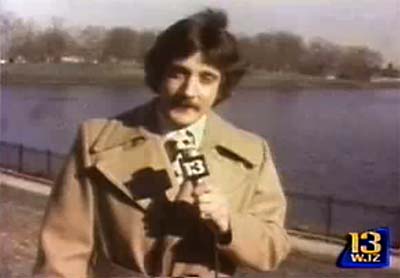
Baltimore was just supposed to be a brief stop on the way to big-time TV success.

Some brief stop. Two decades later, Marty Bass is still plugging away on WJZ, Channel 13, doing the weather, playing Costello to Don Scott’s Abbott, firming up his reputation as one of the most irrepressible (some might prefer incorrigible) talents on Baltimore’s airwaves.

A native of Kentucky, Bass has spent the past 16 years as co-host of WJZ’s morning show, a ratings champion that outdraws the competition by a greater margin than any other local weekday news show. While Scott is no slouch, much of the show’s popularity can be attributed to Bass, who has one of those bombastic personalities people either love or hate.

Judging by the ratings, not many people do the latter.

“I think the reason we are a success is familiarity,” says Bass, whose on-air shtick has ranged from throwing his toupee into a wastebasket (in 1987) to scolding a rival station for what he felt were misleading claims about their weather forecasts (in 1997). “The audience knows what to expect. There’s a certain synergy there,” he says.

In addition, he suspects, viewers believe he and Scott are just like them.

“We are honest with each other and with the viewers about ourselves,” he says. “There’s not a lot of inside-the-locker-room discussion or humor. Whatever we talk about is what you and your neighbors could relate to.”

Bass arrived at WJZ in late 1977, four months removed from Southern Illinois University and four months into a gig as a feature reporter for KENS-TV in San Antonio. Hired to do the weather, Bass had good reason to suspect he wouldn’t be staying at WJZ long: The station already had a weatherman, Bob Turk.

“I took the job really to get in with Group W,” Bass says, referring to WJZ’s parent company, Westinghouse.

“It was made crystal clear from the beginning that there was no chance of ever getting the late news here, the 6 and 11. So I figured, that’s fine, I’ll get a foundation with the company. Actually, I had my eyes set on San Francisco. But after a while, it became pretty obvious that I was working out here.”

So Bass became a victim of his own success — but, he insists, a happy victim.

“I came here with the intentions of using it as a platform to move on,” he says. “I never realized the platform to move on to would be here in Baltimore.”

From weekend weatherman, Bass was tapped by his bosses in 1982 to co-anchor their new morning show — first alongside Oprah Winfrey, who would soon leave the station and fade into obscurity (well, not exactly ), and then Scott, with whom he had been working weekends for about two years.

“I try to bring my act up to Don’s level on a daily basis,” says Bass, who cites his partner — along with local broadcast legends Al Sanders and Jerry Turner — as his biggest influences.

As much as Bass has enjoyed his time in the Baltimore limelight, it hasn’t all been smooth sailing. In December 1985, he was arrested on charges of soliciting a lewd act from an undercover Baltimore police officer. He was cleared the next month after a judge ruled it was unclear just what Bass — who claimed he was researching a story on prostitution — had asked the woman.

“It was real interesting on many different levels,” Bass says of the controversy, which made him the subject of national news attention and the target of every wiseacre in town.

“I am the sum total of all my life experiences,” he says. “If that’s a part of it, then fine. I like who I am now. I like how I am as I approach 45 years old.

“Every once in a while, somebody will come up and say some kind of stupid thing, normally to try and impress a date. But they gave me a long contract [at WJZ] because I’m a good ad-libber; don’t get in this ring with me. I usually hit him with, ‘That’s been over 10 years ago. I’ve grown up, why don’t you?’ That usually puts an end to the conversation real quick.”
Posted in 1990s, Baltimorons, Marty Bass, Vices | Tagged | 3 Comments

Judged by His Beers

By Charles Cohen (Baltimore City Paper, 6/16/2004)

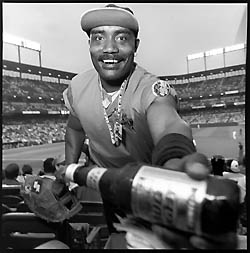
Photo by Sam Holden

The Orioles may think they sell status with Camden Yards skyboxes, but true O’s fans know they’ve really earned their way into an exclusive club when they make it onto Fancy Clancy’s short list.

If a fan is deemed worthy, Fancy Clancy (aka Clarence Haskett), one of the greatest beer vendors to ever work the Yards, will run that customer a tab.

A tab at a baseball game? Now that’s good livin’.

Talk to some of the longtime customers in Haskett’s territory, among the box seats on the first-base side of the field, and they’ll likely gush about the honor of being handed a beer without having to dig in their pockets for a few crumpled dollars to pass down the row to the vendor.

Haskett’s regulars talk about this perk as if they made the guest list of a sold-out show or snagged a table at a booked-up trendy restaurant. For some, the only thing that could make getting the Haskett treatment any better would be if Eddie Murray or Cal Ripken handed over the beer.

“It’s like the greatest accomplishment in my life,” says Gary Hollenbeck, an O’s season ticket holder who tipped Haskett heavily for three years, hoping his favorite beer vendor would someday allow him to run a tab.

Continue reading “Judged by His Beers” at Baltimore City Paper.

Posted in 2000s, Baltimorons, Beer, Orioles, Sports | Tagged , , , , | Leave a comment

Negro Mountain History

Source: Western Maryland Regional Library - www.whilbr.org

Western Maryland’s Historical Library: Negro Mountain

The most commonly accepted historical account as to how Negro Mountain received its name can be traced to the 1750s. Colonel Thomas Cresap and his black body-servant, “Nemesis,” were tracking a group of American Indians who some say had attacked a settlement near present-day Oldtown in Allegany County. It was said a family had been murdered and horses stolen. Others write Nemesis was requested to accompany a ranging party that regularly scouted the frontier in order to protect homes from attack. Either way, Nemesis had a premonition he would not return.

One evening while cleaning his weapon, Nemesis told Cresap that he would not be coming back. Cresap thought Nemesis was afraid, or going to runaway. He “jestingly” offered Nemesis the opportunity to remain behind with the women if he was afraid. Nemesis replied he was not scared, but simply stating a fact. Cresap’s party pursued the Indians over present-day Savage and Meadow Mountains, to the next mountain where a fierce battle ensured. Nemesis fought bravely, was killed, and buried on the site.

Cresap named the mountain in honor of Nemesis’ race and it has ever since been known as “Negro Mountain.” Nemesis was said to have been a large and powerfully built man. “Negro Mountain” remains a memorial and historic tribute to the presence of this black frontiersman.

Based upon research undertaken by historian Francis Zumbrun, a letter sent to the Maryland Gazette in 1756 by Thomas Cresap explains the naming of the mountain. It states that it was a free black man who had accompanied his volunteer rangers during the French and Indian War and who had died heroically in the battle while saving Cresap’s life. Zumbrun, a retired forester for the Maryland Department of Natural Resources and local historian, also notes that the mountain is named in honor of one of the earliest “free” black frontiersman on record in American colonial history.

Continue reading “Negro Mountain” at Western Maryland’s Historical Library.

* * *

Photo by By J. J. Prats, August 11, 2006

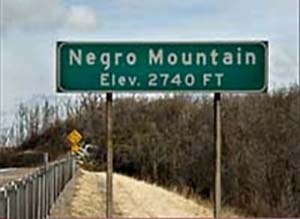
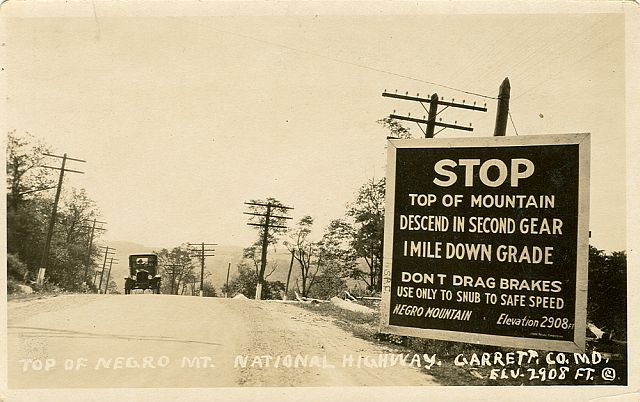
Negro Mountain: The Highest Point on the National Road

“…The Naming of Negro Mountain. Nemesis, a black frontiersman, was killed here while fighting Indians with Maryland frontiersman Thomas Cresap in the 1750s. Legend tells us that he had a premonition of his death. In his honor, they named this mountain after him.”

Continue reading “Negro Mountain: The Highest Point on the National Road” at The Historical Marker Database.

* * *

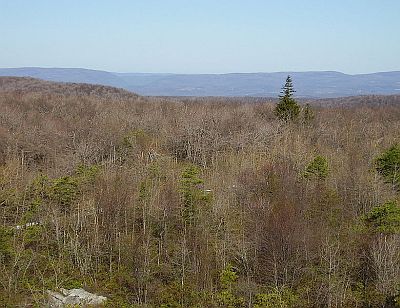
View west from Negro Mountain highpoint. (Photo credit: Wikipedia.org)

Wikipedia.org: Negro Mountain

Controversy

In July 2007, Pennsylvania State Representative Rosita C. Youngblood (Democrat of Philadelphia’s 198th District) called for the renaming of Negro Mountain. In a news release, she said, “Through a school project, my son and granddaughter first informed me of the name of this range and I found it to be disparaging that we have one of our great works of nature named as such… I find it disheartening for tourists who visit this range to see the plaque with the name Negro Mountain displayed on the mountainside.” However, Professor Christopher Bracey, a law professor and associate professor of African and African-American studies at Washington University in St. Louis has said, “I must confess I have a slightly different take on it than [Youngblood]… Here we have a mountain, whose name was intended to be a testament to Negro bravery. It seems rather crass and unsophisticated to name it Negro Mountain, but the intentions were strong.”[5][6] On 1 August 2007, Youngblood and other lawmakers introduced House Resolution No. 378 [7] resolving that the governor “form a commission …to study the naming of Negro Mountain and Mount Davis …[to] adopt names that accurately reflect the history of the region and the heroism displayed by the African American in the Negro Mountain conflict of 1756” and accordingly to alter “brochures, plaques and signs [to] accurately reflect the facts of this heroic historical event”.

Continue reading “Negro Mountain” at Wikipedia.org.

Posted in Black History, Roadside Attractions, Urban Legends | 41 Comments

Maryland Bill Seeks To Rename Negro, Polish Mountains

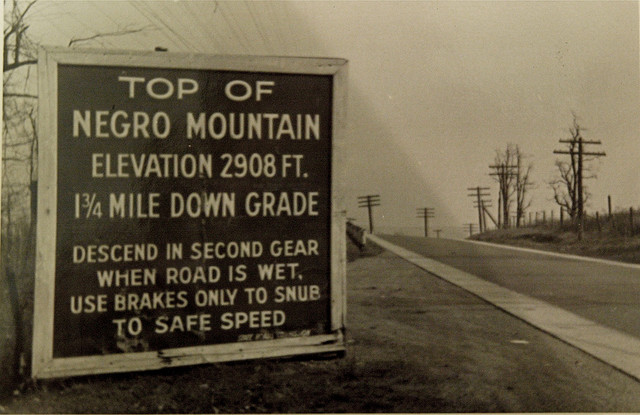
Top of Negro Mountain along US 40, 1938. Photo by Lois Reed.

By The Associated Press (Myfoxdc.com, 2/7/2011)

CUMBERLAND, Md. – A Maryland state senator said Monday that she has introduced a bill seeking to rename two Appalachian peaks, Negro Mountain and Polish Mountain, citing cultural sensitivities.

Lawmakers Speak to FOX 5 About the Bill To Rename Negro, Polish Mountains: MyFoxDC.com

State Sen. Lisa Gladden, a Baltimore Democrat, said she was joined by eight other Democratic co-sponsors in offering a proposal that would seek to create a commission to come up with new names by year’s end. She said new names are needed to more accurately reflect the history and culture of Maryland’s western Appalachian region near the state line with Pennsylvania.

Gladden said the name Negro Mountain has bothered her for years.

“Negro is a term that often has carried with it negative connotations about African-Americans,” Gladden told The Associated Press by telephone. “As we talk about inclusion and respect, Negro Mountain doesn’t fit.”

Yet lawmakers from the state’s mountainous western panhandle said the bill reflects political correctness taken to an extreme by legislators in Baltimore and Maryland’s Washington suburbs.

Lawmakers Speak to FOX 5 About the Bill To Rename Negro, Polish Mountains: MyFoxDC.com

“It’s just asinine,” Delegate Kevin Kelly, an Allegany Democrat, told the Cumberland Times-News.

The bill revives a debate that last peaked in the mid-1990s when the Domestic Names Committee of the U.S. Board of Geographic Names refused to rechristen Negro Mountain as Black Hero Mountain. The committee found that the mountain’s name was not applied in a derogatory sense.

Supporters say Negro Mountain is dedicated to the heroism of an 18th century black man, though details are unclear. There is little in the historical record on the origins of the name Polish Mountain.

Sen. Jennie Forehand, a Montgomery Democrat, said both Negro and Polish mountains should have prettier names.

“Maybe I don’t know the history of how those mountains got named but I think if they were in my district, I would like to have a name that was perhaps more scenic,” she told AP.

* * *

Senators: Local mountains need new names

Western Maryland representatives don’t support push to change Negro, Polish

by Matthew Bieniek (The Cumberland Times, 2/9/2011)

CUMBERLAND — Two local mountains need new names, a group of state senators say, and they want a commission created to select new monikers for Negro Mountain and Polish Mountain which “reflect more accurately the history and culture of the region within which they are located.”

None of the nine senators sponsoring Senate Joint Resolution 3 represent the region where the two mountains rise in the Allegheny Mountain range, with Negro Mountain in Garrett County reaching a height of 3,075 feet and Polish Mountain in Allegany County climbing 1,783 feet from sea level.

The senate resolution isn’t too popular with the legislators who do represent those who live on and near the mountains.

“It’s just asinine,” said Delegate Kevin Kelly. Kelly wondered why Polish Mountain ended up in the resolution. “I’m of Irish descent. We’d love to have a mountain named after us. Let’s rename it Irish Mountain,” he quipped. State Sen. George Edwards and Delegate Wendell Beitzel joined in the skepticism.

“I grew up on Negro Mountain and have a farm on Negro Mountain. I don’t know why people in the Baltimore area are so worried about it,” said Beitzel. The mountain, he said, was actually named in the language of the time in tribute to a black man’s heroism.

“It boils down to the political correctness stuff we’re into in this world,” said Edwards. “The name, at the time, was meant with honor and respect.” Edwards also said he doesn’t think Maryland has the authority to change the name of a mountain. The U.S. Board on Geographic Names of The National Geologic Survey has that authority and has previously rejected a name change, he said.

The history behind the names isn’t simple to pin down, especially in the case of Polish Mountain. It looks like the explanation Beitzel has heard about Negro Mountain is correct.

Champ Zumbrun, a retired forester who managed Green Ridge State Forest for many years, has researched local history and is working on a book on Maryland frontiersman Thomas Cresap. His co-authors include some of Cresap’s descendants. He’s found a letter Cresap sent to the Maryland Gazette in 1756, explaining the event which led to the naming of the mountain.

“The name honors one of our earliest black frontiersmen,” said Zumbrun. Cresap wrote that a free black man, who was a member of his volunteer rangers during the French and Indian War, acted heroically during a battle with Indians, and in fact saved Cresap’s life. The black frontiersman was mortally wounded in the battle and was buried on the mountain.

Another account provided by the Garrett County Historical Society largely agrees with that account.

“I suggest and recommend the name of Negro Mountain remain unchanged, as it is named in honor of a brave black frontiersman, one of the earliest “free” black frontiersman on record in American colonial history serving the cause of liberty against British tyranny, who saved on that mountain the life of Colonel Thomas Cresap, allowing the opportunity for Col. Thomas Cresap to contribute soon thereafter significantly to the American liberties we all enjoy today,” Zumbrun wrote in an email to the Times-News.

Zumbrun says a deed he’s seen from 1790 refers to “Polished Mountain,” but beyond that, Zumbrun has little evidence about the way the name developed, “things get changed over time,” he said. The rocks on the mountain tend to shine when wet, and the leaves of the Aspen trees which once covered the mountain can also be shiny, he said.

Kelly wondered why the senators backing the resolution wouldn’t want to rename organizations with seemingly politically incorrect, but historically significant names, like the NAACP or The United Negro College Fund, he said.

The resolution would require the governor to establish and appoint the members of the naming commission, who would be required to decide on new names by Dec. 31.

Sen. Joan Conway, one of the sponsors of the resolution, did not return a Friday phone call from the Times-News. Conway represents Baltimore.

For a complete article by Zumbrun on the naming of Negro Mountain, see http:// www.whilbr.org/itemdetail.aspx?idEntry=3024&dtPointer=2

* * *

Bill Would Rename Negro and Polish Mountains

By Mark Weaver (WMAL.com, 2/7/2011)

ANNAPOLIS, Md. — A state senator has introduced legislation to rename two Maryland mountains – Negro Mountain and Polish Mountain.

Senator Lisa Gladden, a Baltimore Democrat, says the name Negro Mountain has bothered her for years.

However lawmakers from the state’s mountainous western panhandle said the bill reflects political correctness taken to an extreme by legislators in Baltimore and Maryland’s Washington suburbs.

“It’s totally asinine. It is political correctness run amok,” Delegate Kevin Kelly, an Allegany Democrat, told 630 WMAL News.

“It [Negro Mountain] was named in honor of a black individual and I don’t know how Polish Mountain got into the bill,” said Kelly.

“Maybe the sponsors of the bill need to contact the United Negro College Fund to change that name or the NAACP and remove colored”, said Kelly, who predicts the legislation will fail.

In the mid-1990s the Domestic Names Committee of the U.S. Board of Geographic Names refused to rename Negro Mountain as Black Hero Mountain. The committee found that the mountain’s name was not applied in a derogatory sense.

The Highest Point on the National Road
Posted in 2010s, Baltimorons, Black History, Politics, Roadside Attractions, Urban Legends | 8 Comments