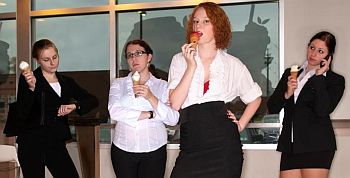
Adult-themed festival planned in Canton causes controversy

Touch of Flavor Festival’ to discuss erotic bondage, offer nudity

(WBAL-TV, 5/3/2013)

A racy adult-themed convention is coming to a popular Baltimore-owned arena, but its controversial topics has some angry, and the city is responding.

touchofflavor

Organizers of the Touch of Flavor Festival at Canton’s DuBurns Arena have billed it as an event to get educated on topics like erotic bondage. The company’s website on Thursday said attendees could be topless for the classes, and full nudity would be allowed for an after-party.

DuBurns Arena sits in an area where families come for the playground, waterfront views and the athletic fields. But over the weekend of May 18, the arena is scheduled to host the festival.

According to its website, the adults-only event is for those who want to “spice things up” and make the most out of their relationships. The two-day festival includes classroom sessions on things like role play, erotic massage and sexual skills and techniques. It also includes workshops on topics like rope bondage.

Continue reading “Adult-themed festival planned in Canton causes controversy” at WBAL-TV.

Posted in 2010s, Fells Point, Sex | Leave a comment

Rocket to Venus: The Great Baltimore Space Program of 1928

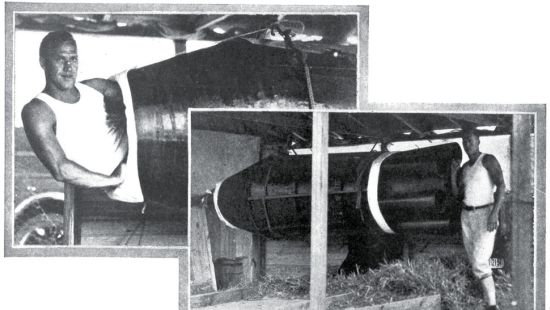
The prehistory of spaceflight is filled with mad scientists. Some of their work led directly to the development of space exploration…others had a much weirder destiny. Such was the case with Robert Condit, who built a rocket in 1928 that he planned to fly from Baltimore to Venus.

By Ron Miller (io9, 5/2/2013)

k-bigpic

Condit’s spaceship was a 24-foot-long bullet made of angle iron and sailcloth. It was constructed with the aid of brothers Harry B. and Sterling Uhler of Baltimore—-where the launch was to take place.

Apparently Condit, described as a “Miami chemist”, had built an earlier rocket in his home state. His goal had been Venus then, as well (the rocket was to have been guided to the planet by “polarized magnetic controls”).

The Baltimore rocket was fueled with 50 gallons of gasoline with eight steel pipes for engines. The several layers of sailcloth that covered the rocket were impregnated with varnish making an airtight shell “as brittle as glass.”

Continue reading “The Great Baltimore Space Program of 1928” at io9.

Related:

Posted in 1920s, Baltimorons, Dining, Roadside Attractions | Leave a comment

CrabTowne USA — The Real Pinball Wizard

(Directed by Jeff Krulik, Edited by Greg DeLiso)

Tom Hintenach is THE REAL PINBALL WIZARD. He’s kept over 100 vintage arcade video games and pinball machines in working order for many years, at CrabTowne USA in Glen Burnie, MD. Produced from footage originally shot for the Emmy Award winning MPT original production Eatin’ Crabs, Chesapeake Style, this short takes you back when video arcade games and pinball machines ruled the world! And at CrabTowne USA they still do.

Related:

  • Jeffkrulik.com
  • Video arcade keeps Pac-ing them in: At Crab Towne in Glen Burnie, a collection of vintage arcade video games is like taking a trip back in time. Just don’t forget your quarters — The Baltimore Sun
Posted in Roadside Attractions | Tagged , | 2 Comments

Lost City: The Regent Theater

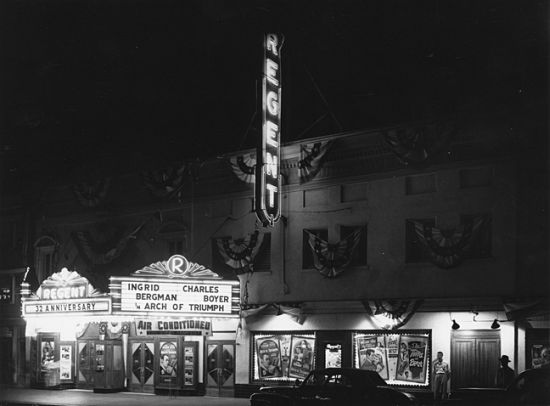
SVF Regent Theater, Baltimore, ca. 1948.

(Maryland Historical Society, 3/21/2013)

The theaters, night clubs, and restaurants that once made Pennsylvania Avenue Baltimore’s center for African-American entertainment are today a receding memory. In the segregated Baltimore of the early to mid twentieth century, the Avenue was where African-Americans went to see the latest films, have a drink at one of the many nightclubs and bars, and hear the jazz of Duke Ellington, Billie Holliday, and Cab Calloway, the comedy of Redd Fox and Slappy White, and the funk of James Brown. Most of the establishments were gone by the end of the 1970s, either occupied by new businesses, laying vacant, or demolished. A few soldiered on—the Sphinx Club, one of the last to go, closed its doors in 1992. The most famous venue on the Avenue, the Royal Theater, was one of the premier stops on the “chitlin’ circuit,” the chain of clubs and theaters running through the eastern and southern states featuring African-American entertainers. While the Royal may have been the best known theater on the Avenue, it wasn’t the largest—that designation would have to go to the Regent Theater.

The Regent Theater was from the start a family operation. On Jun 9, 1916, Louis Hornstein and his two sons, Simon and Isaac, opened the theater on the former site of a coal yard at 1629 Pennsylvania Avenue. Advertised as the “largest, coolest, best ventilated house in the city,” the theater was located in a one-story brick building designed by Baltimore architectural firm Sparklin & Childs. (1) For the next 50 years the Hornstein family owned and operated the Regent. The family later acquired the Lenox and the Diane theaters, also on Pennsylvania Avenue.
cooper2

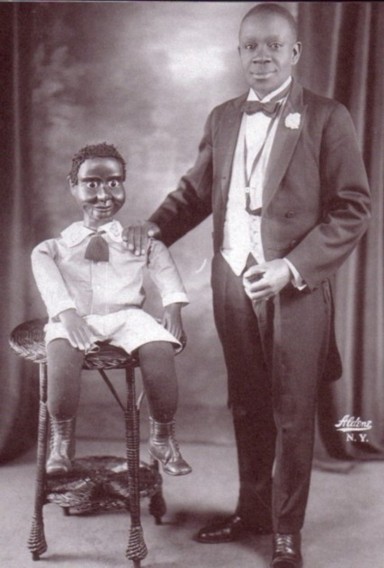
At the time of its opening, the Regent was the largest movie house in Baltimore, with a seating capacity of 500 and its own orchestra. The theater specialized in “high class-photo plays and Vaudeville.”(2) John W. Cooper, the first African-American ventriloquist on the largely white vaudeville circuit, was a bonus attraction on opening night. Billed as “the only colored ventriloquist in the world,” the “Black Napoleon of Ventriloquists,” and the “Polite Ventriloquist,” Cooper’s most famous routine, a barbershop skit, incorporated multiple dummies operated with the use of foot pedals and fishing line.

Continue reading “Lost City: The Regent Theater” at: Maryland Historical Society’s “Underbelly” Blog
Posted in Inner City, Music, Nightspots | Tagged , | 1 Comment