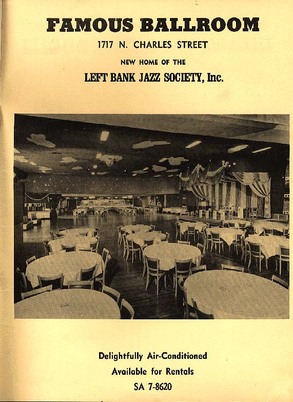
The Famous Ballroom was run by The Left Bank Jazz Society, the nation’s longest running non-profit jazz organization, from 1966-1984.
May 7, 1967
The Famous Ballroom
1717 N. Charles Street
John Coltrane: tenor/soprano sax
Pharoah Sanders: tenor sax & piccolo
Jim Garrison: bass
Rashid Ali: drums
Algie DeWitt: bata drums
On May 7, 1967, the ‘Trane made his last stop just two blocks north of Baltimore’s Pennsylvania Station. That was the day jazz legend John Coltrane made his last professional appearance at Baltimore’s Famous Ballroom, the North Charles Street music club that served as the home of The Left Bank Jazz Society from 1966-1984. Two months later he died from liver cancer, aged 40, shocking a music community unaware of his condition.
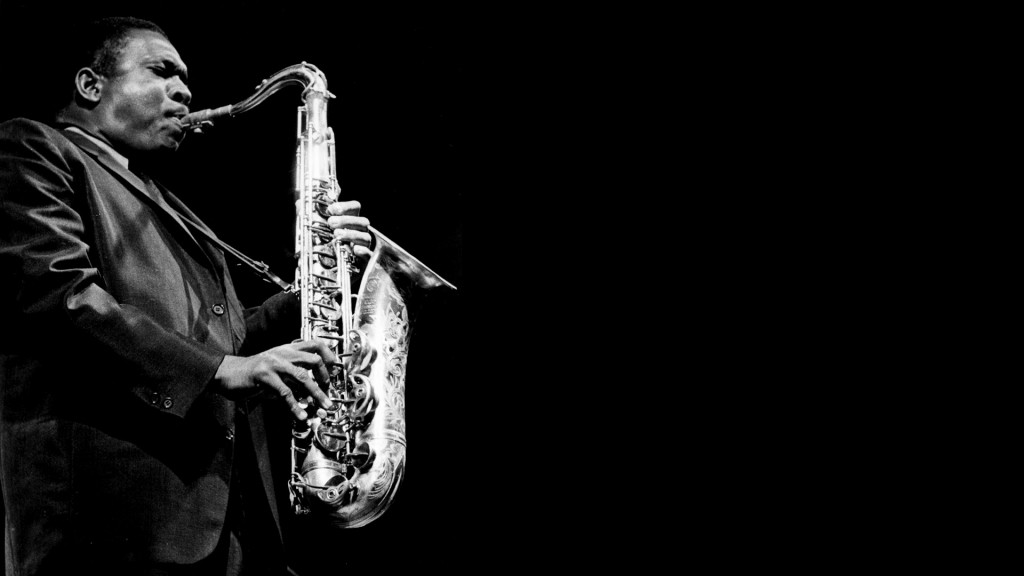
‘Trane kept a rollin’ for the last time, coming to a stop in Baltimore on May 7, 1967.
In her essay on the Left Bank Jazz Society in Mark Osteen and Frank L. Graziano’s Music at the Crossroads: Lives & Legacies of Baltimore Jazz (Apprentice House: Baltimore, MD, 2010), Cathleen Carris wrote of ‘Trane’s last stop:
The date is May 7, 1967, and the place is the Famous Ballroom on North Charles Street, where no one has any idea that they are witnessing the last live performance of world-renowned saxophonist John Coltrane, who will die of liver cancer in just two months. (Baltimore Jazz Scene 1968, 80). The audience is an eclectic array of races, ages, and styles: there are professors from the Peabody Conservatory of Music, college students of all colors, members of the militant Black Panther organization, and middle-aged women dressed in their Sunday best. Yet the only tension in the air is the sound of the music, and the only words exchanged during the performance are “shhhh,” the audience hushed under the weight of the extreme intensity emanating from the stage. Coltrane, accompanied by the other members of his quintet – Pharoah Sanders, tenor sax, Alice Coltrane, piano, Donald Garrett, bass, and Rashid Ali, drums – begins with “Resolution,” a section from his spiritual suite A Love Supreme. Only at the end of the first set, which lasts only two hours, is the spell broken by the group’s rendition of “My Favorite Things,” as Sanders plays the piccolo against Coltrane’s soprano sax. “The ringing brilliance of both instruments enhanced their piercing high notes and rushing arpeggios. The surprise of the afternoon came when Coltrane began to chant against the piccolo, beating his chest. The crowd went wild,” noted one writer in attendance (Stanier, 4).
 That “writer in attendance” mentioned above was Carole Stanier. Stainer wrote a review of the concert called “Every Man Should Have a Jazz He Can Call His Own,” which probably was published in the Left Bank Jazz Society’s 1967 Yearbook. In it, Stainer says neither pianist Alice Coltrane nor bassist Donald Garrett appeared at this show; she speculates that Alice was probably at home caring for newborn son Oran, who was born March 19, 1967. Alice Coltrane and Donald Garrett’s names were erroneously attributed from a pre-concert publicity article in the Baltimore Afro-American.
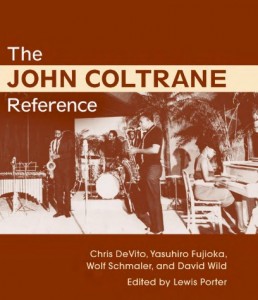
According to the Google Book The John Coltrane Review (by Lewis Porter, Chris DeVito, David Wild, Yasuhiro Fujioka, and Wolf Schmaler), the standing-room-only four-hour (two sets) concert was co-sponsored by the National Brewing Company, which provided free draft beer! No wonder Down Beat magazine reported that “a few hundred others waited outside in the rain to take their places when John Coltrane made his first appearance in in Baltimore before a capacity crowd.”
Fan Jesse Kornbluth was also in the audience that day, and in his review for headbutler.com, “John Coltrane: A Love Supreme,” (which also erroneously cites Alice Coltrane as being there) recalled:
They used to have what was called The Famous Ballroom in Baltimore, where, for $3, you could go any Sunday afternoon and see some of the greatest jazz musicians of that time. It was BYOB, and the place held probably 600 people, at big tables – it was a great way to spend a Sunday. When Coltrane was there, for the first time since I’d been going, the outside went around the block. The place was jammed, as Trane began, accompanied by Pharoah Sanders, Alice Coltrane, Rashid Ali, and I can’t remember who else was in the band. By the end of the second set, the ballroom was half empty. This was not music for this audience. Me, I stood up the whole time, transfixed and enhanced. I was awakened in a way, that day, and I’ve never been the same since. You might say I saw God.
Another audience member, former Sun reporter and author James D. Dilts, wrote of that day’s show, “It was an astonishing performance. Played a year before the Baltimore riots by a man who had a profound feeling for music and whose technical command of the instrument was flawless, it consisted of anguished wails and angry shrieks and hardly a melodic line.” (James D. Dilts, Sun, 1974)
Though the Left Bank Jazz Society produced six CD recordings, “Live at Left Bank,” culled from three decades of live performances taped by LBJS co-founder and emcee Vernon Welsh at various venues (including many from the Famous Ballroom), Coltrane’s 1967 final appearance was, unfortunately, not one of them. It remains the stuff of “I was there” oral history.
A 1968 Left Bank Jazz Society yearbook featured a review of Coltrane’s last show, including this interesting observation: “After expending an incredible amount of energy in a long first set, [Coltrane] sat at the piano bench during his entire intermission, making himself available to the many people who wished to speak with him.”
As Baltimore magazine writer John Lewis wrote in a review of the LBJS (“All That Jazz,” April 2000):
The anecdote says a lot about the atmosphere at the shows, as well as the sophistication of the Left Bank audience. “For years, musicians would tell me about playing for The Left Bank,” Atlantic Records producer Joel Dorn told Baltimore in 2000. ‘Over and over, I’d hear, “They have the hippest audience in the world. A Left Bank audience is like the fourth member of a trio, or the fifth member of a quartet.'”
And the Famous Ballroom was an equally great venue in its day. It was culturally significant in being one of Baltimore’s first racially mixed entertainment venues. “Jazz buffs being color-blind, a special kind of camaraderie took shape at the concerts, at a time when most Baltimoreans did not look kindly on the mixing of the races in any setting,” Gilbert Sandler recalled in Small Town Baltimore: An Album of Memories (Johns Hopkins University Press, 2002).
The Sunday afternoon concerts grew not only into large and memorable events but also into historic ones. For years, on Sunday afternoons from 5:00 p.m. to 8 p.m., the Left Bank Jazz Society entertained with the biggest names in the business: John Coltrane, Miles Davis, Count Basie, Dizzy Gillespie, Earl (Fatha) Hines (who arrived during the 1968 disturbances, with police stopping his bus).
“The place strikes us as a cross as a cross between a concert hall, a night club and a church circle, ” a Sun entertainment critic wrote at the time. “After all, how often can one find first-rate music, barbecue and beer, and a well-dressed audience, all under one starry roof?” He meant that “starry roof” reference literally. The ballroom’s ceiling was painted with stars. (Gilbert Sandler, Small Town Baltimore, 2002)
Most of the shows were held Sunday afternoons after 5 p.m. and in addition to the great music on stage under the stars, there was great soul food being sold from the kitchen: chitterlings, hog maws, collard greens, string beans, and potato salad (you could also bring in your own food and drink).
And 1967 was a banner year for A-list talent at the club, as Kenny Burrell, Jimmy Heath, Roland Kirk, George Benson, Yusef Lateef, Freddie Hubbard, Milt Jackson, and John Coltrane appeared on successive Sundays.
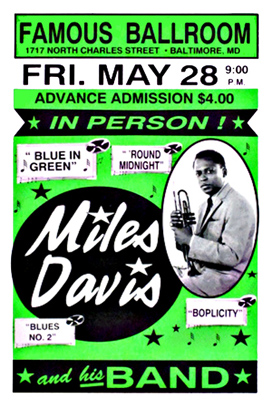
A-list acts frequented the Famous Ballroom its its heyday, as shown in this classic Globe Poster.
Related Links:
“The Closet Tapes” (James D. Dilts, City Paper, 2000)
“Ghosts of the Famous” (James D. Dilts, Sun, 1991)