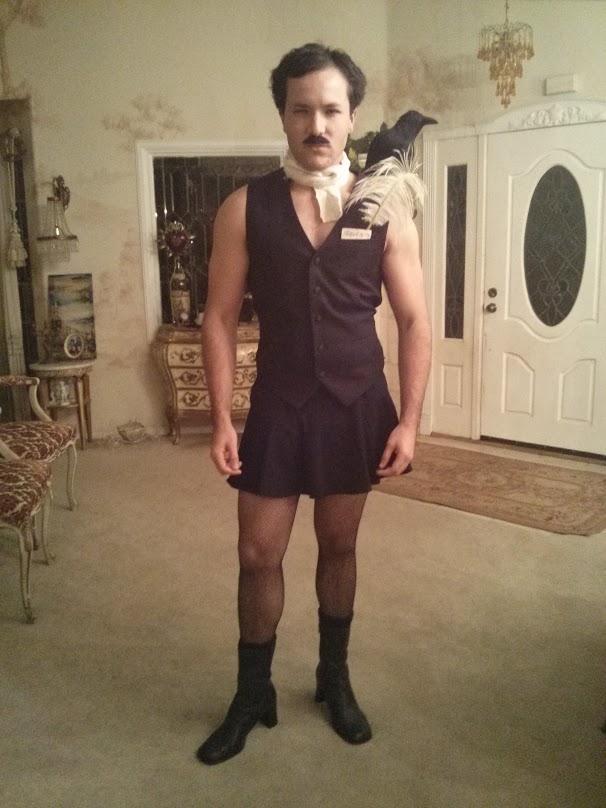
“I decided to get a little creative this year. I present Edgar Allan Ho” by zacch on reddit.com
[As Halloween fast approaches, Frederick N. Rasmussen has written an excellent capsule history of this mythical local monster that appears in today’s Baltimore Sun: “Spinning the tale of the Snallygaster.” Check it out – and cautiously look to the skies if you’re anywhere near South Mountain in Western Maryland!]
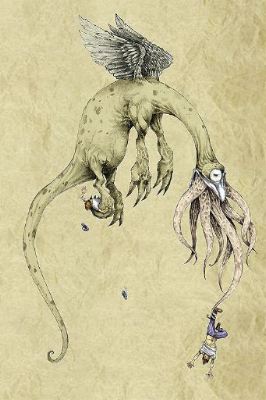
Beware the Snallygaster! (Illustration by R.M. Hanson)
“Better run and hide…the Snallygaster’s comin’ to get ya!”
by Tom Warner (Baltimore Or Less)
I had never heard of Western Maryland’s long-standing “rural legend” of the Snallygaster – a dragon-like creature described as being half-bird, half-reptile and with a screech like a “locomotive whistle” – until I bought a record called The Legend of the Snallygaster by Frederick, Md., indie garage rock band The Skeptics.
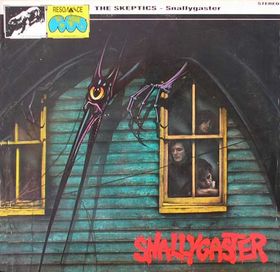
The Skeptics’ “Legend of the Snallygaster” LP (Bona Fide, 1986)
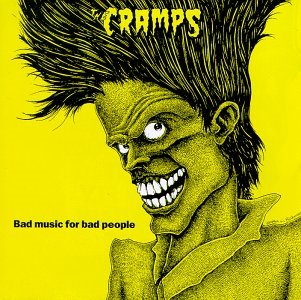 This band – formed in the ’80s and originally comprised of guitarist Andy McCutcheon (whose name should be familiar to anyone who has purchased his family’s fine line of apple products and preserves), bassist Dennis Crolley, and drummer Stephen Blickenstaff (a talented “monster-art” illustrator best known for drawing the Lux Interior caricature appearing on the cover of The Cramps’ 1984 LP Bad Music for Bad People) – released their lone LP in 1986, taking its title from the mythical monster that, according to local lore dating back as far as the 1700s, sweeps down in the dark of night to snatch away small game, farm animals, and even young children. The album – whose art features a razor-beaked, one-eyed Snallygaster designed by Blickenstaff – is best known for the Presidents Day-friendly holiday song “The Ghost of Abraham Lincoln;” local filmmaker and horror-fan Chris LaMartina (President’s Day, WNUF Halloween Special) later directed a stylish music video for the song.
In Snallygaster: The Lost Legend of Frederick County (2011), author Patrick Boyton writes that the Snallygaster has sometimes transcended regional lore to infiltrate pop culture, citing the 1972 children’s book title Fred Flintstone and the Snallygaster Show (albeit as a backwards-flying lion) and Mountain Dew’s 1960s vanilla ice cream soda float the Snallygaster (aka the “Snow White” if made with 7 Up or Sprite).
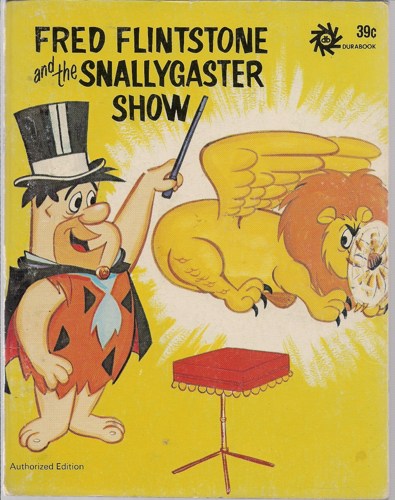
Fred Flintstone and the Snallygaster Show (Durabook, 1972).
Interestingly, in the Flintstones book, Fred describes Snallygasters thusly: “…it flies like a bird, only backwards.It has a nose like an airplane propeller and a head like a lion. And it has very sharp claws, lives in old bowling alleys, and nobody’s ever seen one.”

Fred describes the Snallygaster to an incredulous Wilma.
Boynton also wrote a Halloween-themed children’s book called Beware the Snallygaster (2011), featuring the artwork of Meghan Boehman.
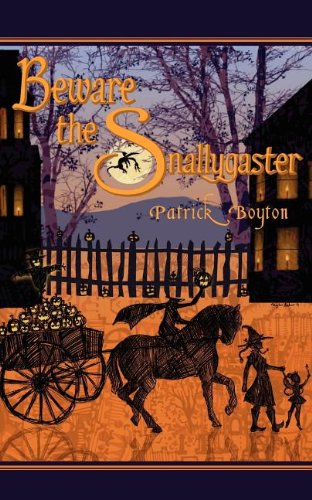
“Beware the Snallygaster” by Patrick Boynton.
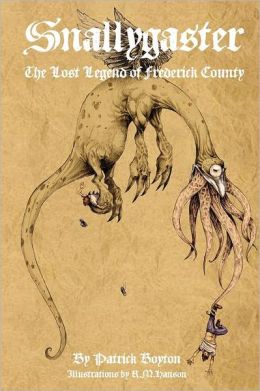
Snallygaster: The Lost legend of Frederick County” by Patrick Boyton.
There’s even an artisinal beer festival named Snallygaster held annually at Washington, DC’s Union Market. The Snallygaster is also described in detail in Ed Okonowicz’s book Monsters of Maryland (Stackpole Books, 2012), as well as other books (a list appears at the end of this post).
The word Snallygaster traces its origin to the German phrase “schneller geist,” meaning quick spirit or ghost, and was probably first used by the German immigrants who settled in the Western Maryland and Southern Pennsylvania regions. And though associated with Frederick County, sightings have also been reported in neighboring Cecil and Washington Counties, Baltimore and Cecil County, and even similar activity in West Virginia and Ohio.
According to Mary K. Mannix (Maryland Room Memories, Gazette.net), the Snallygaster is a Maryland cryptid, a creature that falls “outside of taxonomic records.” Other well-known cryptids include Bigfoot, Sasquatch, the Yeti, the Chupacabra (which must be real because The X-Files did an episode on one!), and the Loch Ness Monster. (Not all cryptids are so far-fetched; the Kangaroo was once considered one. See also: “Top 10 Cryptids That Turned Out to be Real.”) In addition to its wings and claws and affinity for snatching things, its defining characteristic may be it’s lone cyclops eye. Mannix likens it to a flying octopus, an image I rather like (hmmm, I wonder if someone will create a Snallygaster sushi roll?).
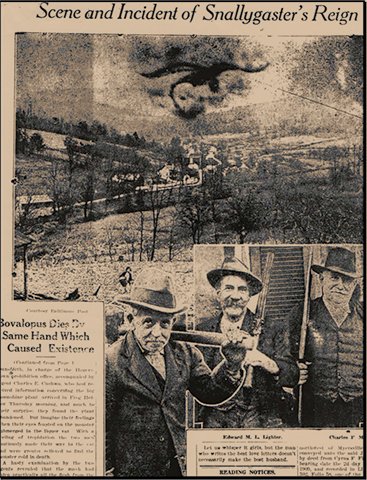
The Middletown Valley Register perpetuated the myth of the winged monster in 1909.
But the aspect of this Blue Mountain monster legend that intrigues me most is learning that in 1909, then-President Teddy Roosevelt allegedly almost cancelled an African safari to instead hunt for this big-beaked game in the wilds of Western Maryland. He must have been reading the sensational headlines in the Middletown Valley Register, where a February 1909 article claimed that a winged creature snatched a man, sank its teeth into his jugular and dropped the drained body off a hillside. The story opened the floodgates to a series of subsequent reported encounters with the creature, which the paper christened the Snallygaster.
Some of those encounters were quite “colorful,” as Susan Fair reported for Blue Ridge Mountain (“Mountain Monster: The Snallygaster“). They included such adventures as “…laying an egg the size of a barrel, picking a railway worker up by his suspenders, and even speaking to one man, mysteriously declaring, ‘My I’m dry, I haven’t had a good drink since I was killed in the battle of Chickamauga!'” (The Battle of Chicamauga! If only Civil War reenactors added the Snallygaster to spice up their battles, I might follow their activities with more interest!)
There was a lull in snallygaster sightings until 1932, when one reportedly crashed into a Middletown moonshiner’s mash barrel. Then, in 1948, a another one was spotted in Westminster. But it wasn’t until the 1970s that there was a true resurgence of sightings. The Baltimore Sun reported that in 1973 Maryland State Police began searching Sykesville for “a huge, hairy monster” standing six- to seven-feet tall with a “bushy tail and black hair” that allegedly killed a cow and some dogs and left behind footprints measuring 13 1/2 inches long and six inches wide. Residents described the beast as a cross between a “dwayyo” (a human-like creature that local folklore claims is hatched from a snallgyaster egg) and a snallygaster. The Sun reported several years later that a man claimed he was chased by a dwayyo along the banks of the Severn River.
Alas, despite its local ties and fearsome characteristics, no one yet has created a Halloween costume of the Snallygaster. Nor has the American Visionary Art Museum’s Kinetic Sculpture Race featured a cryptid critter-themed amphibian vehicle to date. Maybe next year?
Related Links:
Mysteries & Lore of Western Maryland: Snallygasters, Dogmen, and Other Mountain Tales (Susan Fair, History Press, 2013)
Snallygaster: The Lost Legend of Frederick County (Patrick Boyton, 2011)
Beware the Snalylgaster (Patrick Boyton & Meghan Boehman, 2011)
Ghosts and Legends of Frederick County (Timothy Cannon & Nancy Whitmore, 1979)
Beware the Snallygaster (Pulse of the Paranormal site)
Beware the Snallygaster (Gazette.net)
The Eggs-traordinary Egg Lady, Edie Massey Remembered
Edith Massey in her Fells Point shop, Edie’s Shopping Bag, 1978.
By Tom Warner and Scott Huffines (Baltimore Or Less)
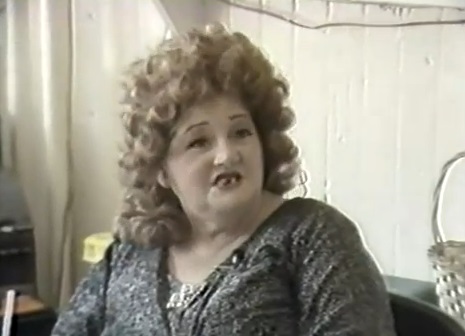
Edith Massey, the popular John Waters “Dreamlander” actress (Multiple Maniacs, Pink Flamingos, Female Trouble, Desperate Living, Polyester), punk singer (Edie and the Eggs), boutique owner (Edith’s Shopping Bag in Fells Point) and greeting card model, passed away this day from cancer and complications resulting from diabetes. Her ashes, fittingly, were interred in the Westwood Village Memorial Park Cemetery in Los Angeles, home of numerous Hollywood stars and entertainment industry celebrities.
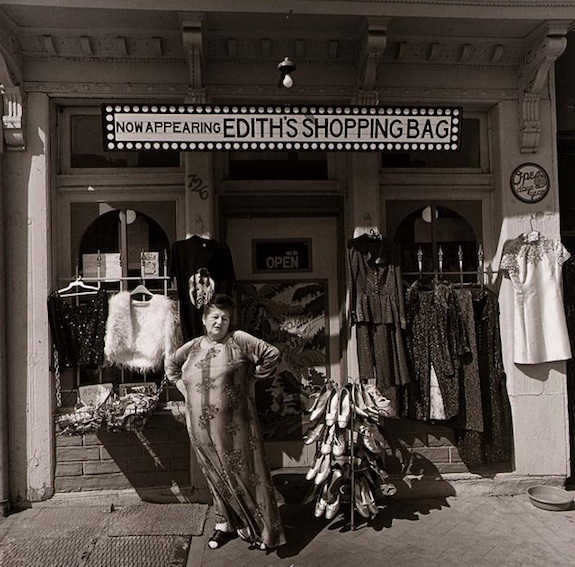
Edith’s Shopping Bag, 726 S. Broadway in Fells Point.
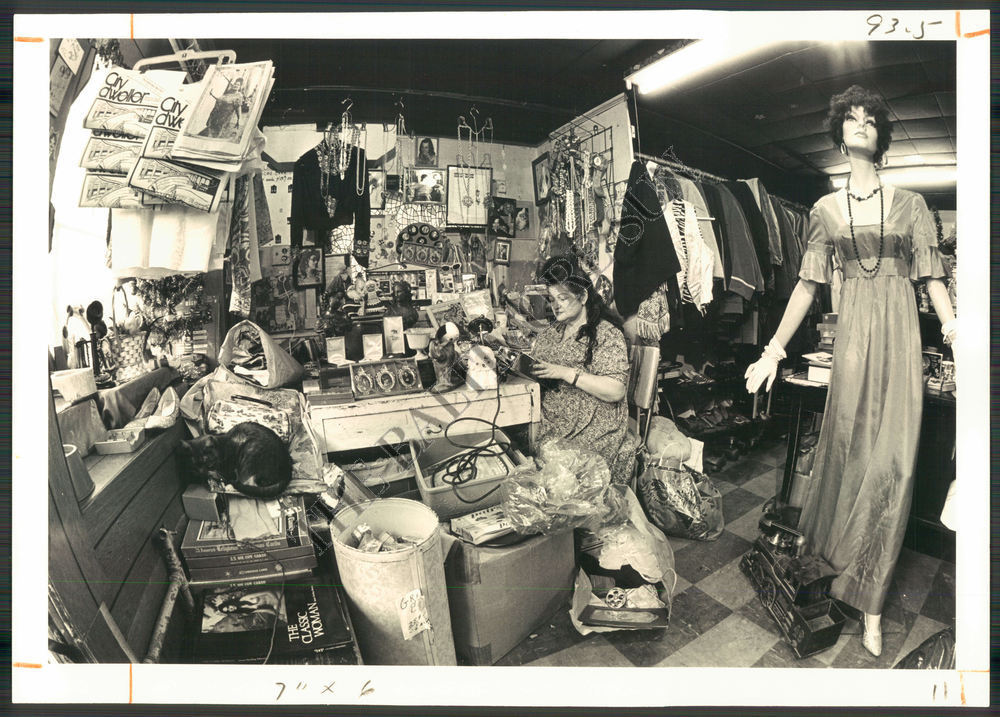
Inside Edie’s Thrift Shop, 1973: “Edie, part-time actress and full-time mother figure for underground movie stars, examines an electrical appliance she was given in her Preston street shop.” (Click photo for hi-res image)
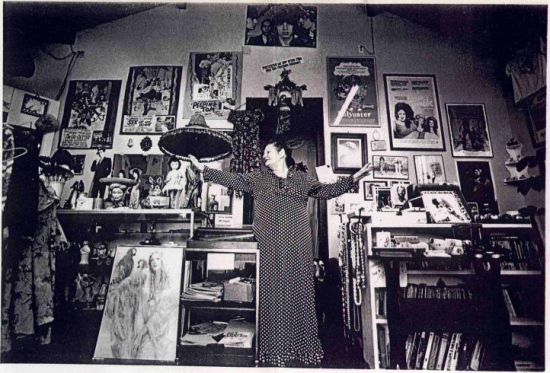
Edie inside her thrift store, which was originally located on Preston Street in Mount Vernon before moving to 726 South Broadway in Fells Point.
Edith will forever be remembered as “Edie the Egg Lady” for her breakthrough role in Waters’ equally breakthrough cult classic Pink Flamingos (1972), though her leather-clad turns as Aunt Ida in Female Trouble (1974) and as evil Queen Carlotta of Mortville in Desperate Living (1977) are just as memorable.
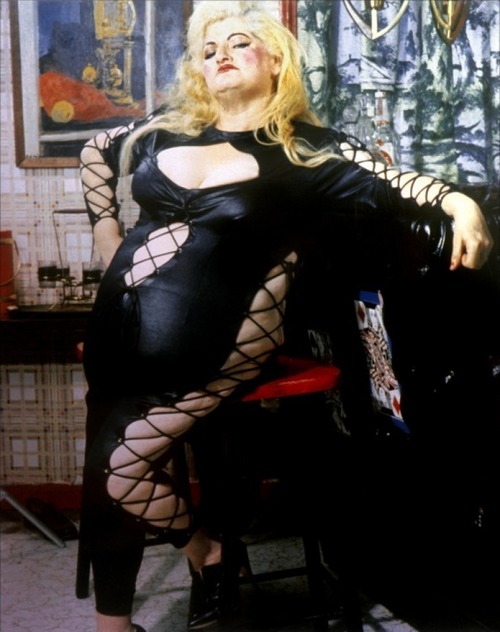
Sexiest outfit ever? Edie as Aunt Ida in “Female Trouble”
Besides her body of work with Waters, Edie’s legacy is preserved in Robert Maier’s 1975 documentary short Love Letter To Edie, the 1976 documentary short Edith’s Shopping Bag, the Steve Yeager documentaries Divine Trash (1998) and In Bad Taste (2000), the 1981 John Cougar Mellencamp music video “This Time,” and her recordings as the singer of the all-girl punk rock band Edie & The Eggs, whose one-time drummer – and Dundalk native (Sacred Heart of Mary class of 1971, hon!) – Gina Schock went on to later fame with The Go-Go’s. (See producer Tom D’Antoni’s Evening Magazine profile of Schock here.)
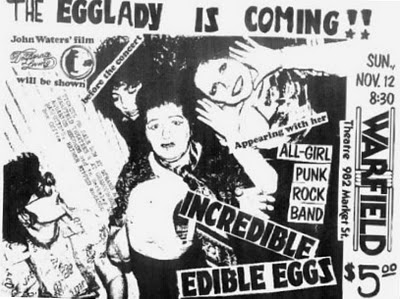
Flier for San Francisco show with Edith Massey – Nov. 12, 1978.
In the 1980s, Edie continued her punk rock act with a number of different backing bands. One of them was Baltimore’s Thee Katatonix, who initially backed Edie at one of her birthday parties with a lineup that included “Danimal” Danny Brown and Adolf Kowalski on guitar and keyboards, “Reverend” Jack Heineken on bass and Big Andy Small on drums.
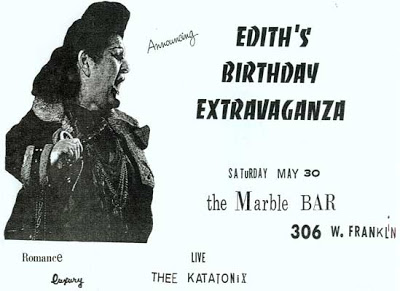
Edie’s Birthday Egg-travaganza at the Marble Bar.
The Kats’ association with the Egg Lady culminated in a two-night stint in 1982 at New York’s Mudd Club, on a bill that included Joe Tex and Sam & Dave and with John Waters in attendance.
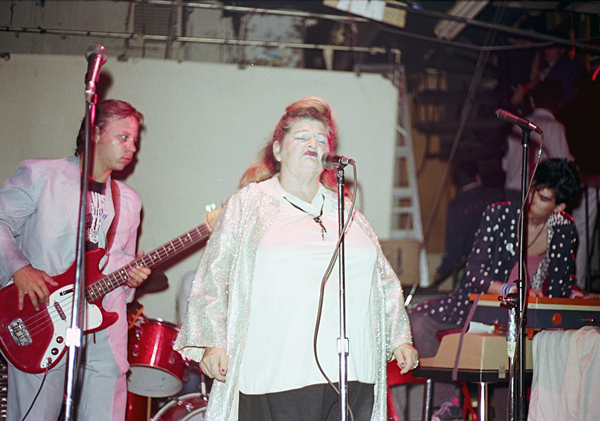
Edie at the Mudd Club, backed by Thee Katatonix.
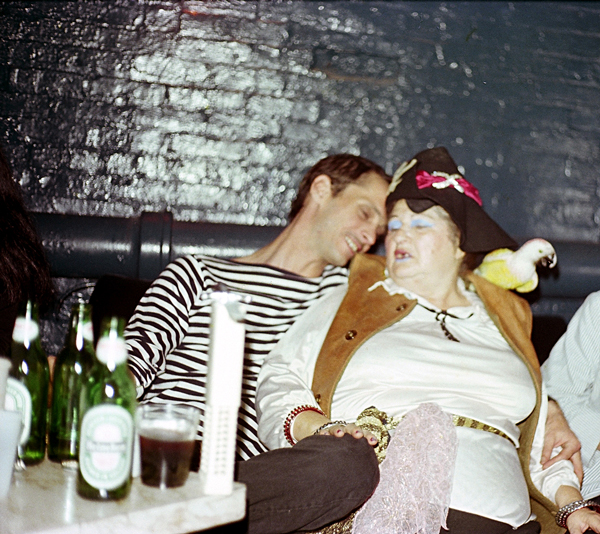
Edie and John Waters at the Mudd Club.
But perhaps the zenith of Massey’s career came when she graced the May/June 1980 cover of the esteemed cinema journal Film Comment. From Egg Lady to glossy Cover Girl – who knew?

“Film Comment” cover girl, May/June 1980.
Edith always dreamed of more glamorous Hollywood roles and even auditioned for a part in a non-Waters film, Paul Bartel’s 1985 comedy Western Lust in the Dust (which featured her Polyester co-stars Divine and Tab Hunter), before before sidelined by health issues.
She eventually got her teeth fixed late in life by Baltimore dentist/video producer-editor Ron Israel (who weened producers Tom Warner and Scott Huffines during Atomic TV‘s late-’90s infancy on Baltimore City public access television), who talks about Massey in a bonus feature appearing on the extremely rare Criterion Collection laserdisc of Polyester (1981). As Baltimore Sun writer Bill Thomas reported (“Edith, the Toothless,” Dec. 17, 1982), when Massey lost her last remaining tooth in 1982, Dr. Ron made her two sets of new ones – one full pair for formal occasions and another one with just her signature solo snaggle tooth for the movies.
When Baltimore’s cold winters became too much for her to handle, Massey moved to Venice, California, where she operated another thrift store until her untimely death in 1984. She was, and will continue to be, missed.
Below, see some of our favorites sights and sounds from Edie’s colorful and entertaining life on screen and on stage.
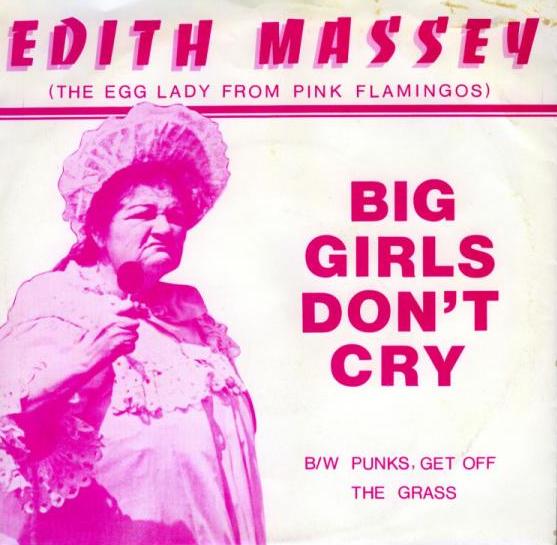
Massey’s “Big Girls Don’t Cry” b/w “Hey Punks, Get Off the Grass” 45 (Egg Records, 1982)
Listen to Edie singing Frankie Valli & The Four Seasons’ “Big Girls Don’t Cry.”
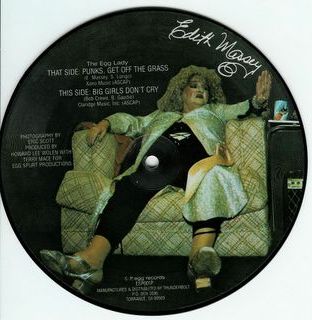
Edith Massey 7-inch picture disc (Egg Records, 1982)
Listen to Edie & The Eggs sing “Hey Punks, Get Off the Grass” live on the Sunset Strip in 1979, with Baltimoreans Gina Schock on drums and Ann Collier (formerly of Charm City’s all-female band Rhumboogie) on guitar.
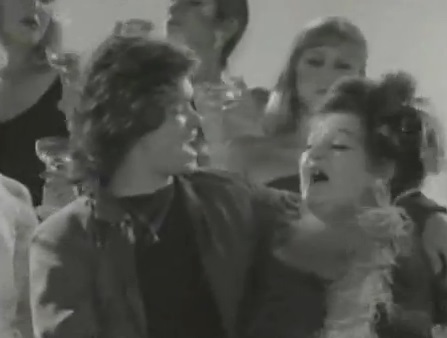
Cougar Town: Mellencamp and Massey camp it up in “This Time.”
Check out Mellencamp and Massey in the music video “This Time.”
You can hear Edie the Egg Lady soundbites sampled in the Thrill Kill Cult music video “Days of Swine and Roses.”
“Edith Massey Conquers Godzilla”
Check out Evening Magazine’s 1978 profile of Edie in “Edie: Queen of Fells Point.”
Watch a clip from Robert Maier’s short Love Letter To Edie.
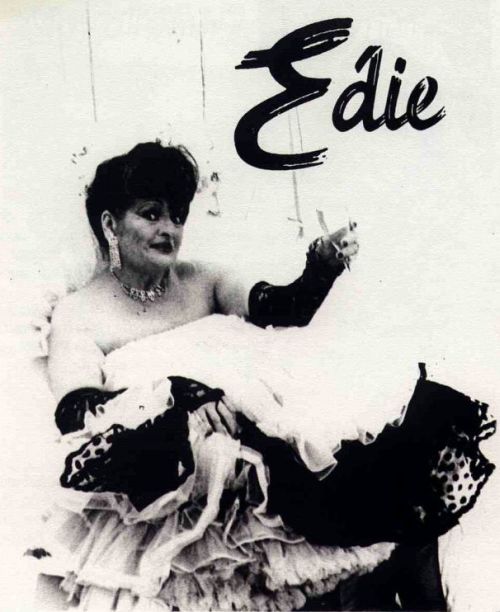
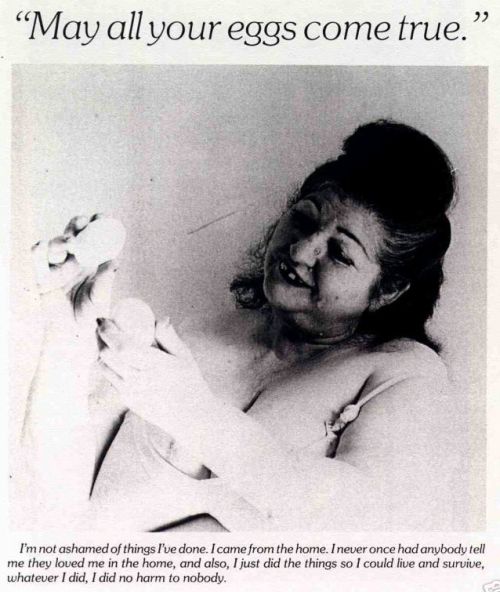
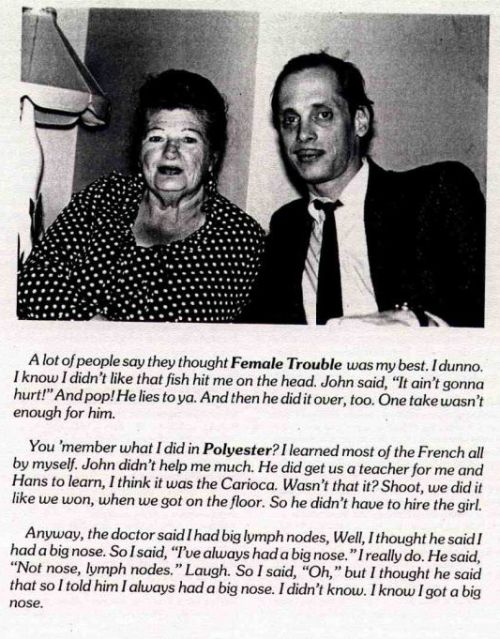
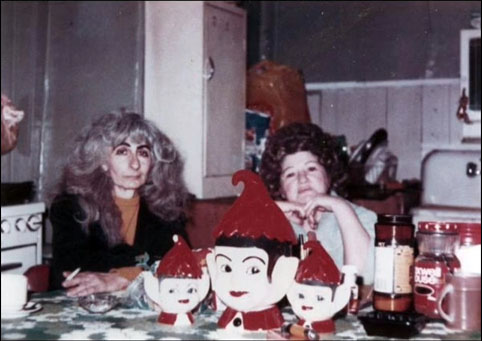
Edith celebrates Christmas with Edith’s Shopping Bag assistant Jean and some elves.
Egg Lady on Tumblr (posts tagged #egg lady)
by Tom Warner (Baltimore Or Less)
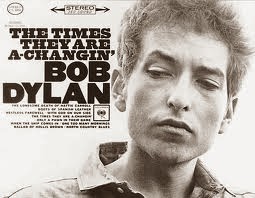
(October 23, 2013) – The northwest corner of Baltimore and Calvert streets, where the main office of the SunTrust Bank now stands, was the setting for one of Bob Dylan‘s best songs and one of Baltimore’s worst moments. Dylan’s “The Lonesome Death of Hattie Carroll“ – recorded 50 years ago today (it appears on the The Times They Are A-Changin’ LP) – is a moving, although somewhat inaccurate (call it poetic license), account of a real-life incident that occurred there on the night of February 9, 1963, in what was then the Emerson Hotel.
William Zanzinger killed poor Hattie Carroll
With a cane that he twirled ’round his diamond-ringed finger
At a Baltimore hotel, society gathering
And the cops was called in and his weapon took from him
And they rode him in custody down to the station
And charged William Zanzinger with first-degree murder
Listen to Bob Dylan play “The Lonesome Death of Hattie Carroll.”
Bob Dylan – The Lonesome Death Of Hattie Carroll
It’s true that William Zantzinger (Dylan inexplicably dropped the “t” in his song), a 24-year-old white tobacco farmer from Charles County, was attending a society ball at the Emerson Hotel that night. And, by all accounts, he was drunk, disorderly, and offensive, especially with his lightweight carnival cane, which he liked to tap people with to get their attention. And it’s also true that he struck a black waitress, Hattie Carroll, once above the right shoulder with that cane when she didn’t fetch his bourbon and ginger ale as fast as he would have liked it.

Illustration by Tom Chalkley (City Paper, December 7, 1992)
Though she collapsed moments later, she neither fell “under a rain of blows,” as some press reports claimed, nor was she killed by that single stroke of William Zantzinger’s flimsy cane. Rather, it was the inhumanity of the racial slur that accompanied this blow – “You black bitch” Zantzinger bellowed – that triggered, in the medical examiner’s words, a “tremendous emotional upsurge” in the 51-year-old mother of nine (not ten as referenced in Dylan’s song).

“Matron Felled By Cane in ‘Old Plantation’ Setting” (Baltimore Afro-American, February 1963)
Given that Hattie Carroll was not in the best of health (she suffered from arteriosclerosis and hypertension) and was described by her friends as accutely sensitive, most likely it was the shock of William Zantzinger’s words that brought on the cerebral hemorrhage that claimed her life eight hours later at Mercy Hospital.

On August 28, 1963, Judge D. Kenneth McLaughlin sentenced William Zantzinger to six months’ imprisonment, declaring, “We find that Hattie Carroll’s death was not due solely to disease, but that it was caused by the defendant’s verbal insults, coupled with an actual assault, and that he is guilty of manslaughter.”
Those were the facts, but they were dwarfed in significance by what the case had some to symbolize in those nascent days of the civil rights movement. To the press, to civil-rights leaders, and to a folk singer in New York City, William Zantzinger represented the plantation-owner mentality of the still lingering antebellum South, while Hattie Carroll represented the oppression of all underprivileged people, regardless of race, creed, or religion. Details didn’t matter in what became, in Sun reporter David Simon‘s words, a “morality play.” (Simon’s excellent analysis, “The Case of Hattie Carroll,” appeared in the February 7, 1988, Sun Magazine.)
You’d think being the villain in a morality play would be enough infamy to last anybody a lifetime, but William Zantzinger managed to outdo himself and was in the news again in late 1991 when he pleaded guilty to 50 misdemeanor counts of unfair and deceptive trade practices for collecting rent on run-down Charles County properties he no longer owned. Before the county seized Patuxent Woods shanties from Zantzinger in 1986 for failing to pay taxes on them, his record as a landlord was far from exemplary. Patuxent Woods was a virtual rural slum, with dirt roads and no indoor plumbing. In January of 1992, Zantzinger was sentenced to 18 months in jail (he spent only nights in jail), fined $62,000, and ordered to perform 2,400 hours of community service for local groups that advocate low-cost housing. Having lived down his image as a racist plantation owner, Zanzinger managed to gain new notoriety as its modern equivalent – the slumlord.
(Portions of this article originally appeared in my “Raising Cane” contribution to the December 7, 1992 City Paper article “Baltimore Babylon.”)
For more on this story, see WYPR’s podcast “The Lonesome Death of Hattie Carroll” (“Maryland Morning,” October 23, 2013), which includes Dylan biographer Howard Sounes’ 30-minute BBC Radio 4 documentary about the song. Sounes’ Dylan biography Down the Highway: The Life of Bob Dylan (2001) is the best I’ve read to date and his BBC report is fantastic; not only did Sounes track down William Zantzinger’s notorious cane, but listeners get to listen to Zantzinger “cursing Dylan unrepentedly” in what is believed to be his only recorded interview before his death at age 69 on January 3, 2009.
Related Links:
True Lies: The Lonesome Death of Hattie Carroll (Planetslade.com)
Fifty Years Later, Hattie Carroll’s Death Remembered (Afro, March 8, 2013)

